Giant’s Causeway: why cooling rock makes columns
Cracks give shrinking rock more room. As the cracking front moves, neighboring cracks trace out columns.
At the Giant’s Causeway in Northern Ireland, a close approach shows groups of exposed stone tops with five, six or other numbers of sides. Step back in the coast photograph and the tops sit at the ends of columns. They are surfaces in a cooled lava body, with edges made where fractures grew through the rock. [1][2][4]
Cooling can make solid rock contract. If a cooler region cannot freely shorten because it is attached to surrounding material, stress builds. Cracking lets part of the rock release that stress. The networks can develop into repeated patterns without any need for perfectly regular shapes. [2][3][4]
← Explore Natural Wonders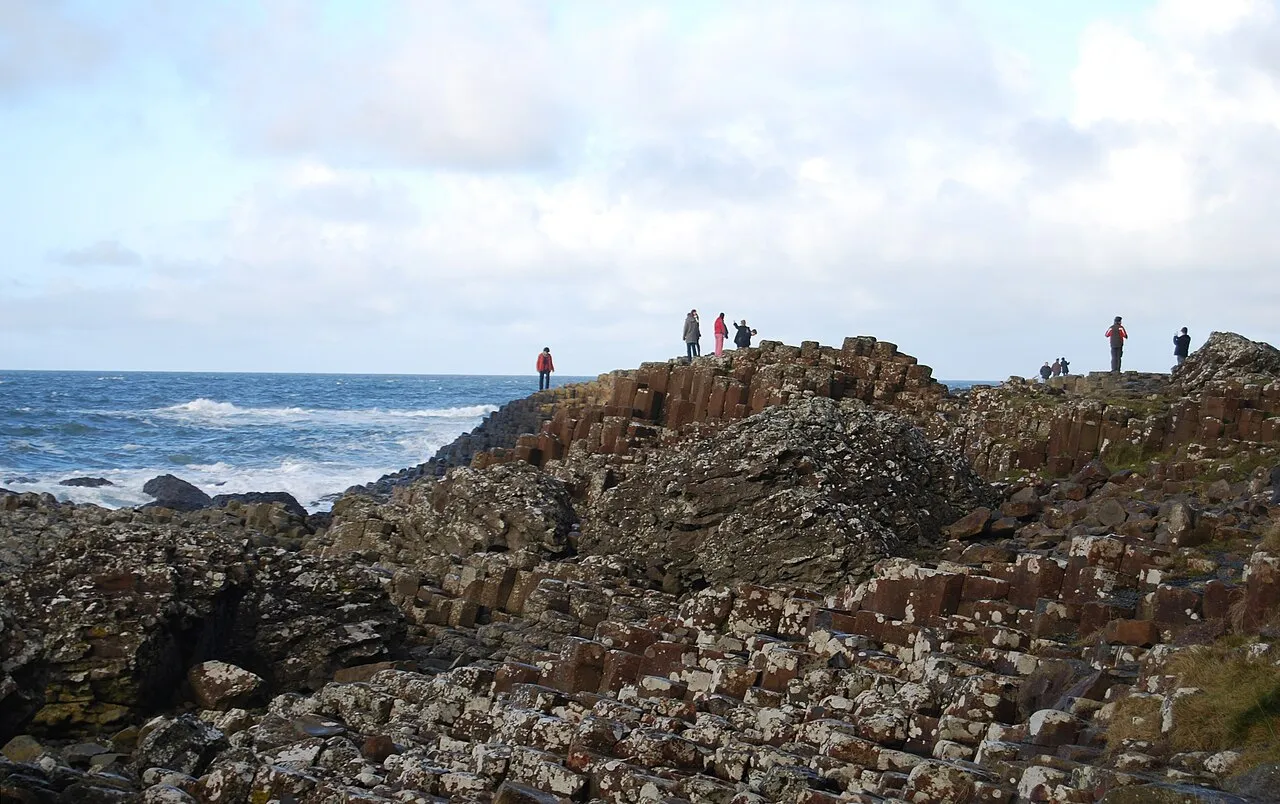
Giant’s Causeway, Northern Ireland. The whole shoreline frame shows columns standing out from the rock and sea.
Giant’s Causeway (6).JPG · Chmee2 · CC BY 3.0 · full frame resized. Image rights ↗ · Image source ↗
A few details change the picture.
A column looks different from above and from its side
In the close view, some flat tops meet their neighbors at clear corners. In the shoreline view, columns stand at different heights and are visible below their upper ends. Read the edges as traces made by fractures, or joints, in rock. Weathering and erosion can reveal the joints and make the tops accessible to view. [1][2]
A single close crop makes the tops look like a design laid across a floor. The wider image preserves the cliff and shoreline context. An apparent surface pattern is more informative when you can also see how far it continues into the rock. [1][2]
A network starts to relieve stress
A lava body can lose heat faster near a cooler boundary. In a layer of solid rock that wants to contract, attachment to other material can set up tension. A crack opens where the rock can no longer sustain the stress. A new crack changes the stress nearby, affecting which way neighboring cracks extend and where they meet. [2][3][4]
As cooling and cracking progress inward from a boundary, many of the joints continue through the solid. They form roughly parallel columns in favorable conditions. Five-sided or seven-sided sections and uneven widths can survive along with more regular ones. The patterns reflect fracture history, not a rule assigning six sides to each column. [3][4]
Separate a laboratory comparison from a local history
Lamur and colleagues measured stress buildup in basalt samples as the samples cooled under constraint. The fractures gave them evidence that cooling contraction can drive cracking in solid rock. The temperature they report applies to their studied material and setup. It is not a thermometer reading from the Causeway. [3]
Research comparing lava joints and drying starch looks at a shared kind of geometry. Starch loses water. Lava loses heat. The measured resemblance helps ask how crack spacing changes as a front moves, while leaving each material’s own physical history in view. Photographs alone cannot tell us the complete path by which cooling advanced at the site. [4][2]
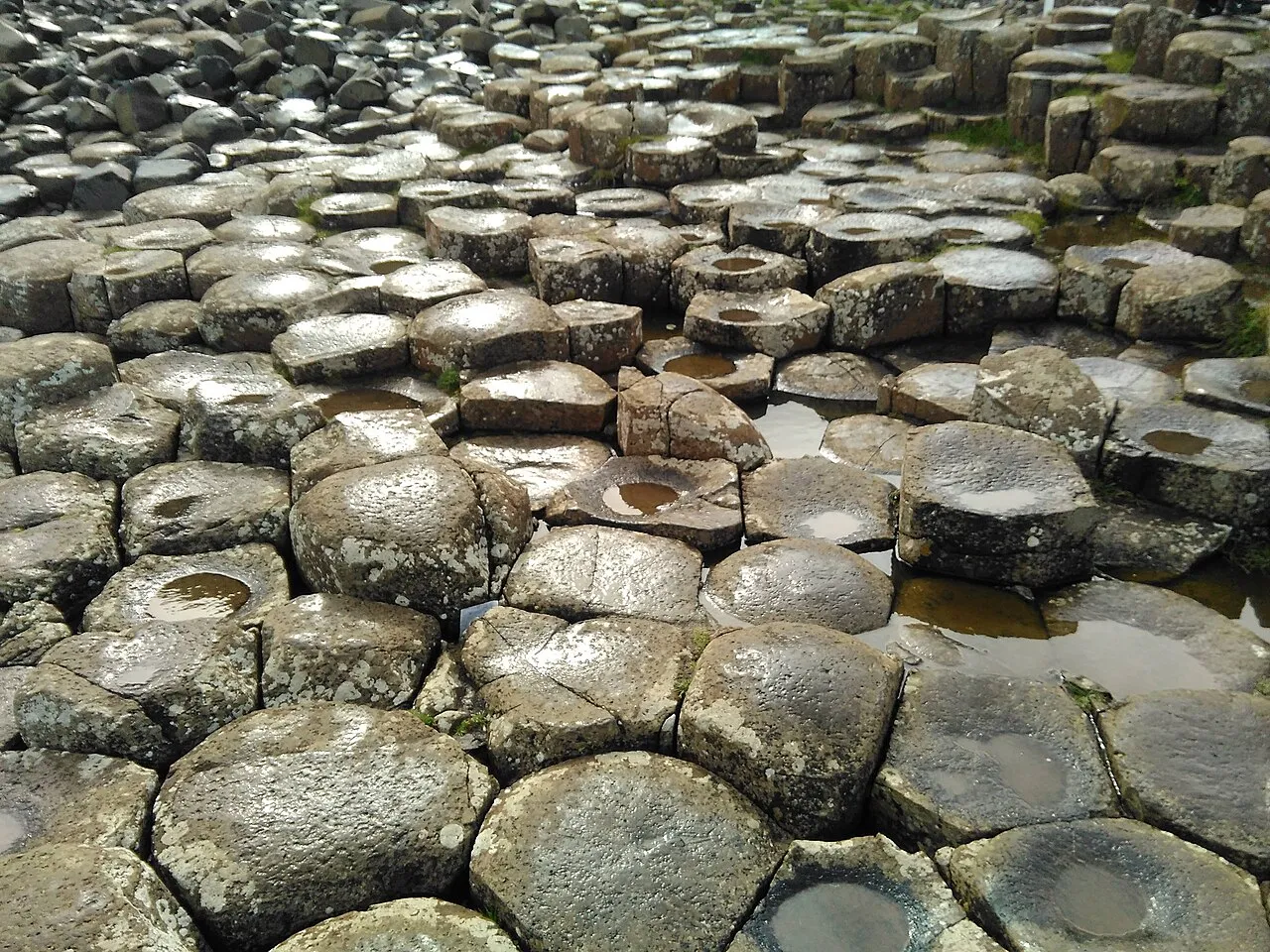
Close view of the polygonal column ends. The companion shoreline photograph places these shapes in the wider site.
Giant’s Causeway Basalt Columns.jpg · DeveshT · CC0 · full frame resized. Image rights ↗ · Image source ↗

Keep a little curiosity.
Enjoying a discovery is enough. These optional questions may become a deeper investigation.
How would you distinguish the direction a joint extended from the angle at which erosion later cut across it?
The photographs show shape, the experiment supports a mechanism, and the local geological history takes more evidence than either alone gives.
A complete CEL answer is not published yet.
Plant a Seed for this question →Sources & image notes.
Facts are tied to the references below. This is a source-checked editorial discovery, rather than an assessment or a claim of independent expert review.
- Giant’s Causeway and Causeway Coast ↗
UNESCO World Heritage Centre. Identifies the County Antrim World Heritage property and the regular columns in its tholeiitic basalts.
Checked 2026-11-17. - The Giant’s Causeway and Causeway Coast ↗
British Geological Survey. Local landscape, basalt and cooling-contraction account; geological context without assigning exact cooling history to each exposure.
Checked 2026-11-17. - Disclosing the temperature of columnar jointing in lavas ↗
Anthony Lamur and colleagues, Nature Communications; University of Liverpool repository. Independent experiment recorded stress buildup and fracture during constrained basalt cooling.
Checked 2026-11-17. - Nonequilibrium scale selection mechanism for columnar jointing ↗
Lucas Goehring, L. Mahadevan and Stephen W. Morris, PNAS. Field and laboratory comparison of crack patterns. Describes fracture fronts and the limited analogy between drying starch and cooling lava.
Checked 2026-11-17.
Image provenance and modifications
Some collection cards show a labelled detail crop. The full image above retains its source framing.
Photograph
Giant’s Causeway, Northern Ireland. The whole shoreline frame shows columns standing out from the rock and sea.
Giant’s Causeway (6).JPG · Chmee2 · CC BY 3.0 · full frame resized.
Creator/publisher: Chmee2 / Wikimedia Commons.
Source record · Original image · Author’s exact Wikimedia file offers CC BY 3.0 as an alternative license. This rendition uses it.


Changes: Full source frame resized and converted to WebP without cropping, retouching or reconstruction.
Rights/source metadata checked 2026-11-17. Images identify the object or work; factual claims rely on the editorial references.
Photograph
Close view of the polygonal column ends. The companion shoreline photograph places these shapes in the wider site.
Giant’s Causeway Basalt Columns.jpg · DeveshT · CC0 · full frame resized.
Creator/publisher: DeveshT / Wikimedia Commons.
Source record · Original image · Exact photograph volunteered under CC0 by its creator on Wikimedia Commons.

Changes: Full source frame resized and converted to WebP without cropping, retouching or reconstruction.
Rights/source metadata checked 2026-11-17. Images identify the object or work; factual claims rely on the editorial references.
Discovery entry.ce3-nature-giants-causeway · revision 1.0.0. Raise a content or image concern →. This prepares a local note; no report is delivered.