Oware (Abapa): where the last seed lands
The last seed can make a move valuable, even when the first few drops look unpromising.
Lift a handful of seeds and imagine dropping one in each house as you move around the board. In Abapa, the final seed can change the meaning of the turn. If it leaves two or three seeds in a house on the other player’s side, that house can start a capture. The same handful dropped from a different starting house can end somewhere else entirely. [1]
← Explore Game Design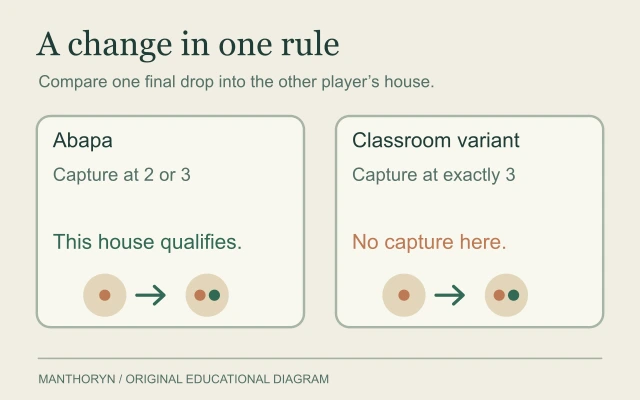
Original diagram of one capture condition. Other houses and the rest of the position are omitted.
Original Manthoryn educational illustration · CC BY 4.0. CC BY 4.0 ↗ · Image source ↗
A few details change the picture.
Count ahead from your starting house
If you pick up seeds from a house, the distribution tells you the route the turn will take. A larger handful reaches farther. The best starting place can therefore depend on how many seeds lie in particular houses ahead, rather than simply which of your own houses contains the most seeds. [1]
Change the test and compare
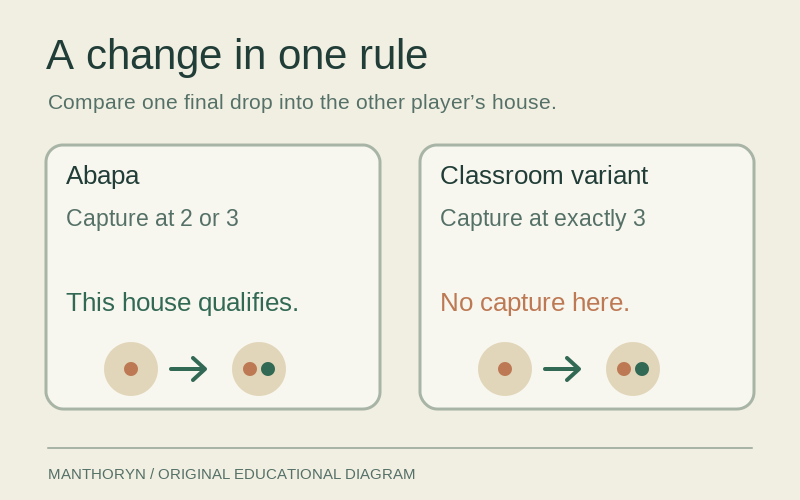
Look at the illustrated final step. One seed is already in the destination. Adding one makes two. Now imagine a classroom rule requiring exactly three seeds for a capture. The same drop no longer qualifies. This changed test is an invented comparison, useful for seeing how one rule can change which destinations a player values. [1]
Why the entire position matters
The documented rules allow some captures to extend backward through consecutive qualifying houses on the other side. The two-or-three condition is only one part of deciding how a full turn resolves. The small example assumes the capture would leave other seeds for the opponent. It does not settle how all end positions or special cases play out. [1]
Keep the name attached to the rules
Oware is used for related forms and local practices. The society’s account distinguishes several forms, including Abapa. Calling the classroom modification a new Oware tradition would erase that distinction. Comparing the actual rule and an invented alternative side by side gives the original practice a clear identity and leaves room for differences elsewhere. [2][1]
Keep a little curiosity.
Enjoying a discovery is enough. These optional questions may become a deeper investigation.
What would you look for several houses ahead before choosing where to start sowing?
Think through the destinations and the final seed under the named Abapa rules.
A complete CEL answer is not published yet.
Plant a Seed for this question →Sources & image notes.
Facts are tied to the references below. This is a source-checked editorial discovery, rather than an assessment or a claim of independent expert review.
- Abapa Rules ↗
The Oware Society. The Oware Society’s complete archived Abapa rules cover setup, sowing, the final-seed condition, consecutive backward capture, feeding and end game. The illustration shows one qualifying house in a partial position.
Checked 2026-11-17. - Oware rules and variants ↗
The Oware Society. The Oware Society’s archived comparison distinguishes Abapa from other forms and explains why regional and language names should not be substituted for documented rule sets.
Checked 2026-11-17.
Image provenance and modifications
Some collection cards show a labelled detail crop. The full image above retains its source framing.
Illustration
Original diagram of one capture condition. Other houses and the rest of the position are omitted.
Original Manthoryn educational illustration · CC BY 4.0.
Creator/publisher: Original Manthoryn educational illustration / Manthoryn.
Source record · Original image · Original Manthoryn educational illustration, licensed under CC BY 4.0 International.
Changes: Original SVG converted proportionally into local WebPs at two widths.
Rights/source metadata checked 2026-11-17. Images identify the object or work; factual claims rely on the editorial references.
Discovery entry.ce3-gaming-oware-abapa · revision 1.0.0. Raise a content or image concern →. This prepares a local note; no report is delivered.