Venus flytrap: from a bent hair to a moving leaf
A very small contact starts an electrical event. A later signal can change what the trap does next.
Walk a small insect across a Venus flytrap in your imagination. One leg brushes a hair on the inner surface. The hair bends and the bend can start an electrical signal in the leaf. The change is easy to miss if you only watch the trap snap. The rapid movement follows a sequence of earlier, smaller events. [1]
← Explore Plants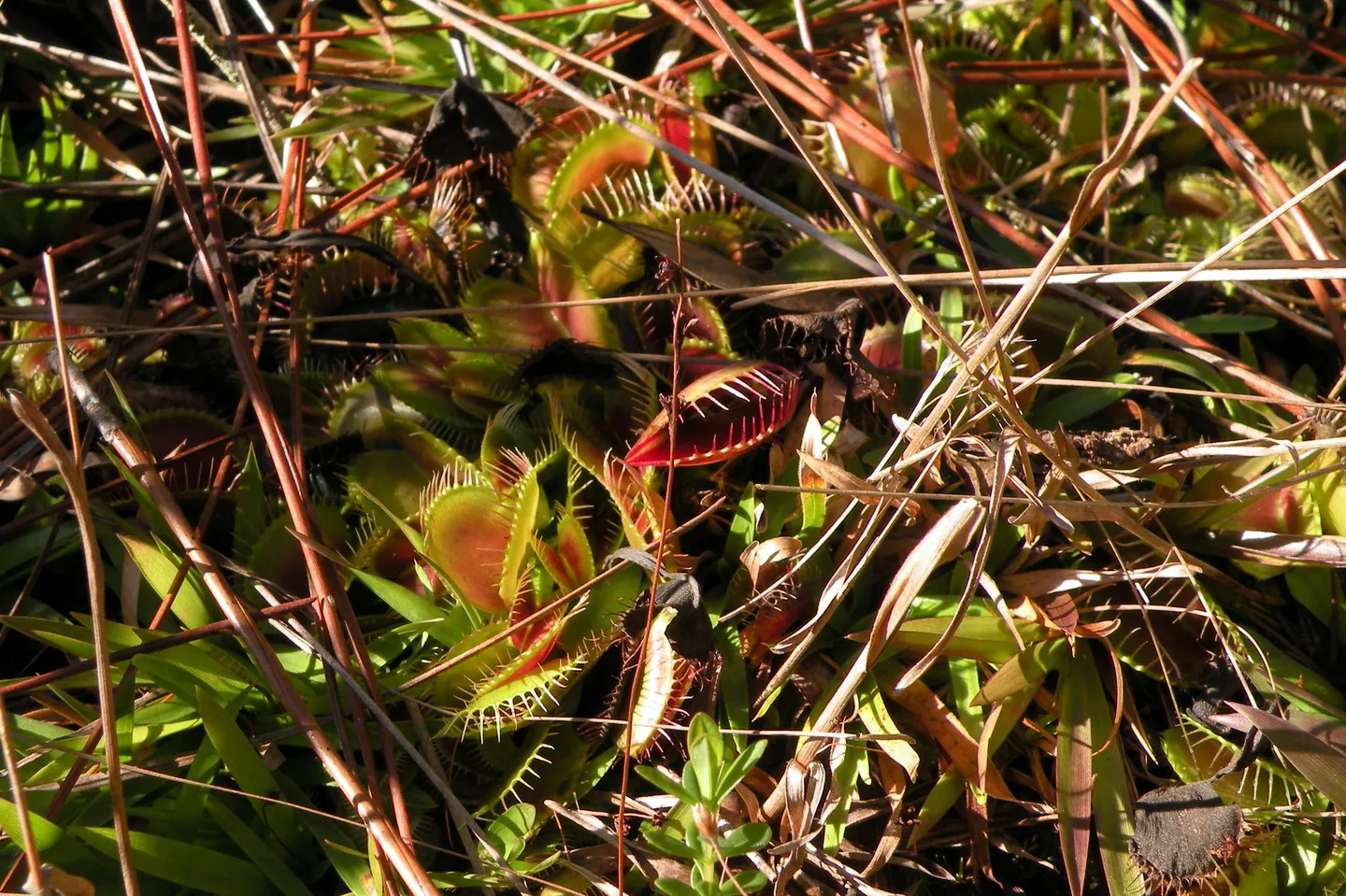
Venus flytraps in their surroundings near Hosford, Florida. The frame shows multiple traps on the ground rather than a relative scale for prey.
Doug McGrady. Dionaea muscipula near Hosford, Florida. CC BY 2.0. CC BY 2.0 ↗ · Image source ↗
A few details change the picture.
From movement to an electrical signal
The hair’s mechanical deflection changes conditions in nearby sensory cells. If the local response crosses a threshold, an action potential can travel from that region through the trap. A light touch and an action potential describe different steps. The first is movement of a hair. The second is an electrical event in the plant tissue. [1][2]
Separate touches from signals
The researchers could measure the signals and observe closure. In their experiments, a suitable pair of electrical events in a short interval preceded a fast snap. The amount and timing of bending influence whether a hair gives rise to an event. It is the measured events, rather than the number of legs that touch the leaf, that provide the useful comparison. [1][2]
A snap is only one part of the sequence
Once closed, the trap can respond to further stimulation. In the reported work, stronger or continuing prey-related signals were associated with subsequent processes, including activation of parts of the digestive response. In the wild, capturing prey lets this photosynthetic plant obtain nutrients in addition to those available through its roots. Closure and nutrient uptake are different outcomes. [1]
Describe the response you can measure
Biologists sometimes describe the plant as retaining a short history of earlier signals. That is a way to summarize a measurable change in responsiveness over a limited interval. The drawing keeps the parts visible: a hair moves, an electrical event occurs and the leaf changes shape. That order provides a good basis for comparing two hypotheses about what a second stimulus does. [1][2]
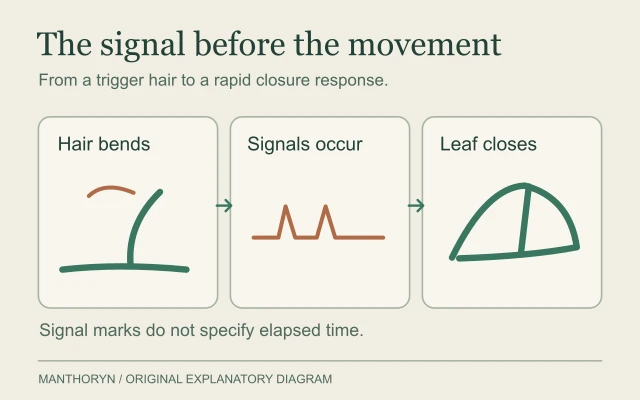
Original conceptual sequence of sensing and closure. Spacing does not encode a time interval or insect size.
Original Manthoryn educational illustration · CC BY 4.0. Image rights ↗ · Image source ↗
Keep a little curiosity.
Enjoying a discovery is enough. These optional questions may become a deeper investigation.
What comparison would help separate the effect of bending one hair more strongly from the effect of bending it twice?
The comparison concerns the meaning of a scientific observation, with natural conditions kept distinct from reported experiments.
A complete CEL answer is not published yet.
Plant a Seed for this question →Sources & image notes.
Facts are tied to the references below. This is a source-checked editorial discovery, rather than an assessment or a claim of independent expert review.
- The Venus Flytrap Dionaea muscipula Counts Prey-Induced Action Potentials to Induce Sodium Uptake ↗
Jennifer Böhm and colleagues, Current Biology. Exact species, trigger-hair stimulation, activation sequence, closure and later responses.
Checked 2026-11-17. - Mechanical factors contributing to the Venus flytrap’s rate-dependent response to stimuli ↗
Royal Society Interface primary study. Experimental response to bending and rate dependence, and the distinction between stimulus and action potentials.
Checked 2026-11-17.
Image provenance and modifications
Some collection cards show a labelled detail crop. The full image above retains its source framing.
Photograph
Venus flytraps in their surroundings near Hosford, Florida. The frame shows multiple traps on the ground rather than a relative scale for prey.
Doug McGrady. Dionaea muscipula near Hosford, Florida. CC BY 2.0.
Creator/publisher: Doug McGrady / Doug McGrady / Flickr.
Source record · Original image · Photographer released the exact Flickr photograph under CC BY 2.0. Wikimedia Commons records its exact license check.


Changes: Original photographic frame preserved in both proportional WebP derivatives. No cropping or alteration of the depicted subject.
Rights/source metadata checked 2026-11-17. Images identify the object or work; factual claims rely on the editorial references.
Illustration
Original conceptual sequence of sensing and closure. Spacing does not encode a time interval or insect size.
Original Manthoryn educational illustration · CC BY 4.0.
Creator/publisher: Original Manthoryn educational illustration / Manthoryn.
Source record · Original image · Original Manthoryn educational illustration, CC BY 4.0 International.
Changes: Original vector artwork proportionally rasterized at two widths.
Rights/source metadata checked 2026-11-17. Images identify the object or work; factual claims rely on the editorial references.
Discovery entry.ce3-nature-venus-flytrap · revision 1.0.0. Raise a content or image concern →. This prepares a local note; no report is delivered.