Djenné’s earthen architecture and maintenance
A surface renewed together carries building knowledge forward.
The Great Mosque at Djenné, Mali, is an earthen building whose surface needs renewal. UNESCO’s Urban Heritage Atlas describes sun-dried earthen brick and mud plaster. Rain can wear down that outer layer. Renewing it keeps an existing building usable and is part of a collective practice known as crépissage. [1][2]
Local accounts explain why the work is more than an annual task on a maintenance list. It calls for gathering materials, deciding when to work, teaching through practice and coordinating different groups. The mosque also remains a place of worship. [2][1]
← Explore Cultures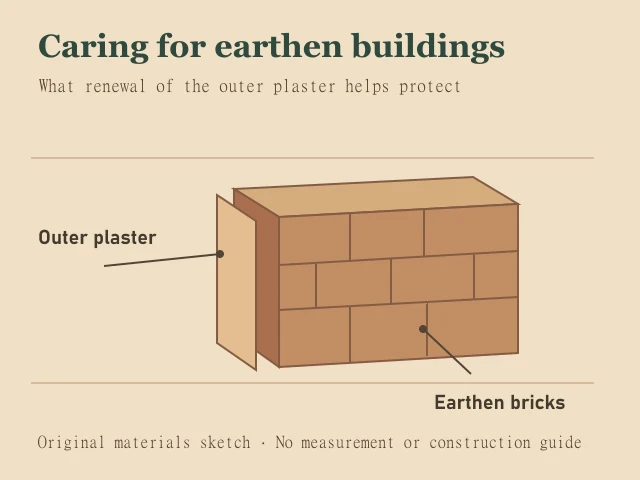
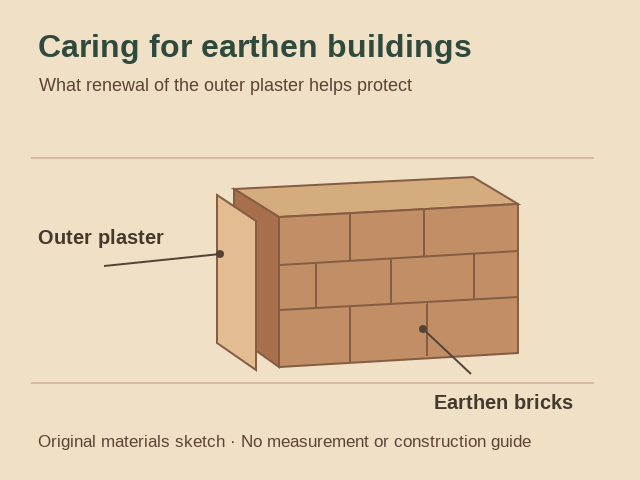
Original materials diagram based on the earthen brick and plaster system described for Djenné. No structure dimensions or people are depicted.
Original Manthoryn educational illustration · CC BY 4.0. CC BY 4.0 ↗ · Image source ↗
A few details change the picture.
See why the outside is repaired
An outer coating can wear before the material behind it needs rebuilding. At Djenné the Urban Heritage Atlas describes an earthen plaster over earthen bricks. The Great Mosque’s projecting timber bundles are visible from outside. The project’s local tour identifies these bundles as supports used in replastering. The work belongs to a particular building and materials, so the description is not a generic construction method. [1][2]
Ask who carries the technique onward
Mason Nouhoum Touré describes instructing and supporting younger masons before plastering. Aïssata Djitteye describes people bringing water and others preparing and moving the material. These accounts give a view of the coordination required. They carry the voices of particular participants. They do not assign the same experience or role to every participant or generation. [2]
Read the event as a collaboration
Yelfa Djeité describes district committees taking part in setting a date and informing community and religious leaders. The sequence shows how material work depends on agreed timing. Religious meaning, practical expertise and shared preparation can all enter one event. Each depends on people and relationships that a photograph of the facade alone cannot show. [2]
Distinguish preserving material and sustaining a practice
The site manager’s contribution to UNESCO’s atlas discusses debates about heritage and how modern buildings and services meet residents’ needs. The mosque shows one form of collective renewal; it does not resolve every question about development or represent a whole region. To understand the building in context, read people’s accounts beside material and conservation records. [1][2]
Keep a little curiosity.
Enjoying a discovery is enough. These optional questions may become a deeper investigation.
What could be lost if a building’s appearance were preserved but the skills of caring for it were no longer passed on?
Use the accounts of people who maintain the place and distinguish material effects from changes in community practice.
A complete CEL answer is not published yet.
Plant a Seed for this question →Sources & image notes.
Facts are tied to the references below. This is a source-checked editorial discovery, rather than an assessment or a claim of independent expert review.
- Urban Heritage Atlas: Old Towns of Djenné ↗
UNESCO World Heritage Centre and Cultural Mission of Djenné. Earthen architecture, Great Mosque context, and site manager Moussa Moriba Diakité’s contribution on contemporary needs.
Checked 2026-11-17. - Great Mosque of Djenné: Transcripts ↗
CyArk Tapestry with named Djenné participants. Stop 4 records explanations by Yelfa Djeité, Nouhoum Touré and Aïssata Djitteye. Stop 6 supplies the worship context.
Checked 2026-11-17.
Image provenance and modifications
Some collection cards show a labelled detail crop. The full image above retains its source framing.
Illustration
Original materials diagram based on the earthen brick and plaster system described for Djenné. No structure dimensions or people are depicted.
Original Manthoryn educational illustration · CC BY 4.0.
Creator/publisher: Original Manthoryn educational illustration / Manthoryn.
Source record · Original image · Original Manthoryn illustration, CC BY 4.0. Third-party imagery excluded.
Changes: Rasterized to two full-frame WebP widths.
Rights/source metadata checked 2026-11-17. Images identify the object or work; factual claims rely on the editorial references.
Discovery entry.ce3-people-djenne-maintenance · revision 1.0.0. Raise a content or image concern →. This prepares a local note; no report is delivered.