Zheng He’s voyages and their records
Follow inscriptions, an eyewitness account and a later chart to one documented port.
When a fleet leaves little surviving logbook evidence, a later reader can still ask what different records agree on. For the fifteenth-century voyages associated with Zheng He, inscriptions record official accounts, Ma Huan describes ports, and historians examine later copies and compilations. Calicut, now called Kozhikode, offers one specific place where those lines of evidence can be compared. [1][3][2]
The question is how to read each source for what it can establish. People who commissioned a stone inscription, an interpreter writing about a port and an editor preserving a chart had different reasons to make their records. Their sources help with different parts of a reconstruction. [1][3]
← Explore Exploration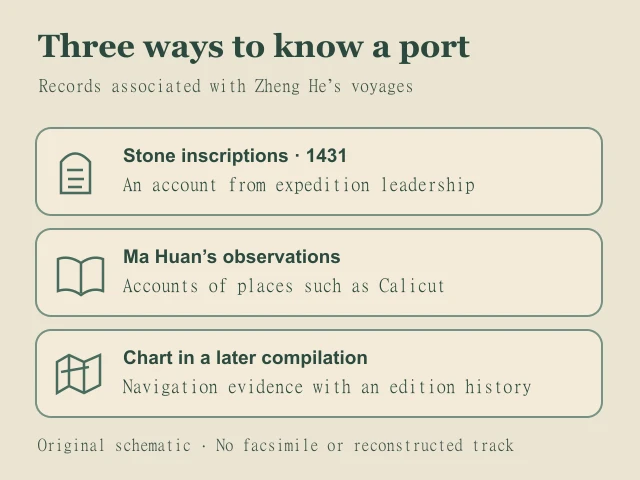
Original guide to the roles of three records. The forms are schematic symbols without a facsimile, decoded inscription or reconstructed voyage track.
Original Manthoryn educational illustration · CC BY 4.0. CC BY 4.0 ↗ · Image source ↗
A few details change the picture.
Read the date of the record separately from the journeys
Translated records from Liujiagang and Changle refer to voyages before or around the time the inscriptions were set up in 1431. Changle gives a list of places and describes particular expeditions. This makes it possible to compare a statement about a voyage with an account dated later. The record represents the expedition leadership’s public version of events. [1][3]
Follow a documented place to another source
In a study of the voyages, Wan Ming examines the early written references to Calicut and compares the expedition records with Ma Huan’s description of the port. Ma Huan’s account supplies detail about encounters and commerce. Details about living and trading there can help explain why a place mattered without revealing the exact course or timing of every ship. [3][2]
Ask which edition preserves the map you can see
A chart reproduced in the University of California’s source packet survives through the Wubei zhi tradition. Its published context comes after the voyages. A chart can point to place names, relative order or navigational information while leaving unresolved who drew a particular line, when it was copied and which ship followed it. The edition date is not the voyage date. [2][3]
Say which parts of a voyage can be checked
Reading Calicut’s name in related records supports a specific historical destination. An estimate of a fleet’s size, an exact modern track or a claimed visit to a different continent needs evidence for that different claim. A reasonable reconstruction marks established place names and dates, and shows separately the intervals, variant names and routes that are still uncertain. [1][3][2]
Keep a little curiosity.
Enjoying a discovery is enough. These optional questions may become a deeper investigation.
How would you weigh a later map and a dated inscription if they appeared to give different names to a port?
Compare language, edition history and referents before selecting a place. This question does not assume an itinerary.
A complete CEL answer is not published yet.
Plant a Seed for this question →Sources & image notes.
Facts are tied to the references below. This is a source-checked editorial discovery, rather than an assessment or a claim of independent expert review.
- Historical Accounts of Zheng He: translated Liujiagang and Changle stelae ↗
Edward L. Dreyer translations; American University course archive. Primary-source appendix, records dated 1431 and compilation context. No numerical claims about fleet scale reused.
Checked 2026-11-17. - Sites of Encounter in the Medieval World: Calicut, primary sources ↗
University of California History-Social Science Project. Primary-source lesson includes translated voyage material and a labelled section of the transmitted chart. Reviewed as evidence only.
Checked 2026-11-17. - Zheng He’s Seven Voyages into the Namoli Ocean–the Indian Ocean ↗
Wan Ming, China and Asia. Original scholarship comparing Ma Huan and translated inscription references to Calicut, including the Changle account.
Checked 2026-11-17.
Image provenance and modifications
Some collection cards show a labelled detail crop. The full image above retains its source framing.
Illustration
Original guide to the roles of three records. The forms are schematic symbols without a facsimile, decoded inscription or reconstructed voyage track.
Original Manthoryn educational illustration · CC BY 4.0.
Creator/publisher: Original Manthoryn educational illustration / Manthoryn.
Source record · Original image · Original Manthoryn illustration, CC BY 4.0. Third-party imagery excluded.
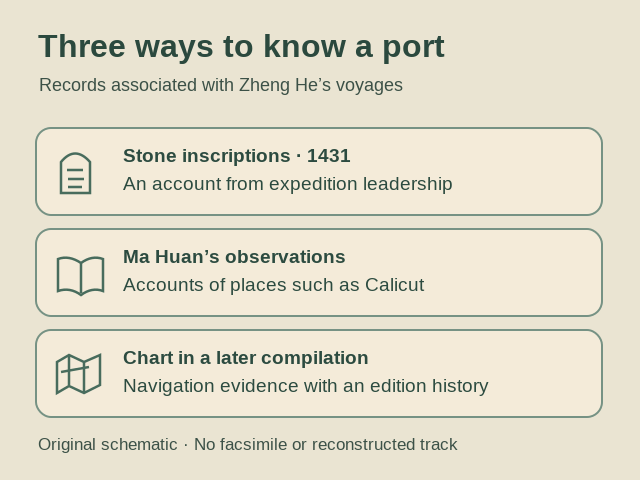
Changes: Rasterized to two full-frame WebP widths.
Rights/source metadata checked 2026-11-17. Images identify the object or work; factual claims rely on the editorial references.
Discovery entry.ce3-people-zheng-he-voyage-records · revision 1.0.0. Raise a content or image concern →. This prepares a local note; no report is delivered.