Rosetta Stone
A comparison that became a tool for testing readings.
The Rosetta Stone presents related versions of a priestly decree issued in 196 BCE. Its surviving inscriptions use Egyptian hieroglyphs, Demotic and Greek. The crucial distinction is three scripts, not three unrelated languages: hieroglyphic and Demotic forms represent Egyptian, alongside Greek. [1]
How can related inscriptions help unlock a writing system? A readable version gives a starting point for comparison. It does not hand the reader a complete symbol-by-symbol dictionary. A proposed reading must fit recurring names and signs, other inscriptions and what is known about the language. [2]
← Explore Languages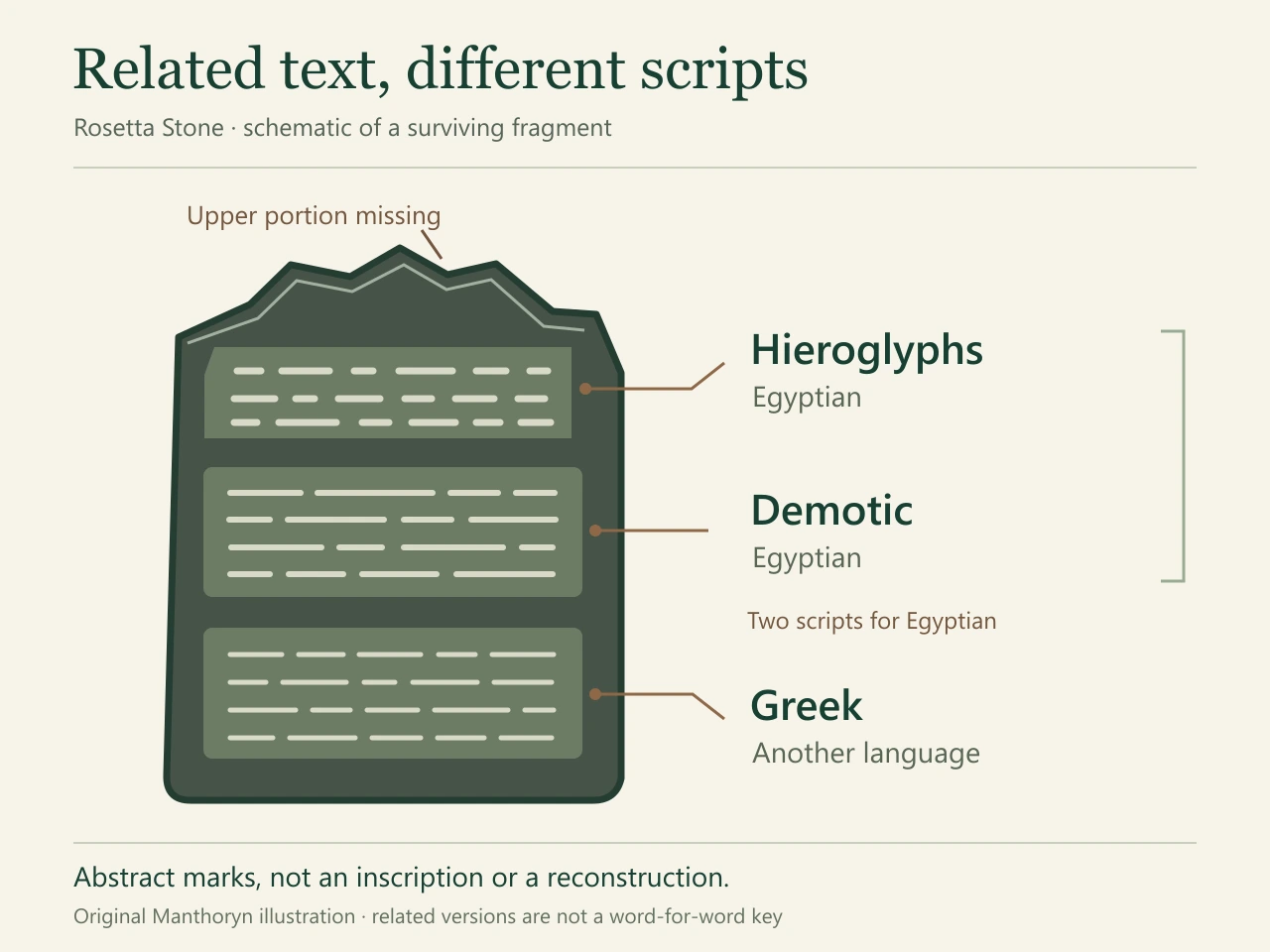
Original educational schematic of the Rosetta Stone comparison: two scripts represent Egyptian, alongside Greek. The outline and abstract text marks are not a documentary image, an exact transcription or a reconstruction of the missing upper portion.
Manthoryn original educational illustration, CC BY 4.0. SVG master and proportionally rasterized WebP renditions. CC BY 4.0 ↗ · Image source ↗
A few details change the picture.
Start with a message that can be compared
Greek was already readable to the scholars studying the stone. The relationship between its text and the other inscriptions offered something more useful than an isolated collection of unfamiliar signs: evidence that different written forms conveyed a related decree. [3]
Think of the Greek as an anchor, not an answer key placed beneath each symbol. Equivalent meaning need not give identical word order or one sign for every letter. The task was to discover the workings of the writing, rather than align two columns mechanically. [2]
Names offer a testable foothold
The Royal College of Physicians describes Young comparing enclosed hieroglyphic name-groups, called cartouches, with the Greek ruler’s name Ptolemy. This supplied a possible link between signs and sounds. [3]
A foothold is not the completed climb. If a proposed sound value explains one name, the useful next test is whether it helps with another inscription. A reading becomes more persuasive when it survives new comparisons, not simply because its first example looks convincing. [4]
The writing was more than pictures
Earlier approaches often treated hieroglyphs too narrowly as symbolic pictures. The museum’s exhibition account follows the move toward understanding the relationship between sounds and other functions of signs. A recognisable drawing could participate in writing without merely naming the thing it resembled. [3]
This is a general lesson in interpreting an unfamiliar system: appearance does not determine function. A sign that looks like an object still has to be understood in its written context. That is an explanatory point, not a claim that every ancient script works like Egyptian. [2]
A breakthrough with a longer history
The1822 decipherment milestone associated with Champollion followed work by Young and other investigators. The British Museum also places medieval Arab and later European attempts in the longer story. One surviving object became especially useful through comparison with more material. [4]
The physical stone and the knowledge made with it have different histories. It was discovered by French soldiers at Rashid in 1799 and transferred to British possession in the military events of 1801. That history matters when presenting it as an Egyptian object now held in London. [3]
Read the damage as well as the signs
The actual stone’s broken outline is part of the evidence; our schematic indicates that incompleteness without reproducing its inscriptions. This is a fragment, not a complete pristine decree. Missing text and repeated examples from elsewhere make decipherment a problem of checking interpretations against several surviving records. [1]
The satisfying answer is therefore comparison plus testing: a known text constrains possibilities, repeated patterns suggest readings, and other evidence tests them. The stone opened a route into a language; it did not remove the need for linguistic knowledge, collaboration and careful interpretation. [4]
Keep a little curiosity.
Enjoying a discovery is enough. These optional questions may become a deeper investigation.
How can a writing system combine sound-based and meaning-based signs?
A further language question; no current CEL destination is claimed to teach the full mechanism of Egyptian writing.
A complete CEL answer is not published yet.
Plant a Seed for this question →Sources & image notes.
Facts are tied to the references below. This is a source-checked editorial discovery, rather than an assessment or a claim of independent expert review.
- Hieroglyphs: unlocking ancient Egypt — large-print guide ↗
The British Museum. 196 BCE priestly decree, three scripts, surviving fragment and comparisons in decipherment; official indexed passages inspected, direct PDF403.
Checked 2026-11-17. - Hieroglyphs: unlocking ancient Egypt — guide for teachers ↗
The British Museum. Multiple stages of decipherment, Young/Champollion and limitations of earlier symbolic interpretations; official indexed excerpt inspected, direct PDF403.
Checked 2026-11-17. - Thomas Young and the decipherment of hieroglyphics ↗
Royal College of Physicians Museum. 1799 discovery in military context, 1801 British transfer, Young’s name comparisons and later Champollion contribution. Its imprecise three-languages wording is not adopted.
Checked 2026-11-17. - British Museum announces major exhibition on hieroglyphs ↗
The British Museum. Longer history of attempts, multiple scholars and comparison with other inscriptions, 1822 milestone; official indexed excerpt inspected.
Checked 2026-11-17.
Image provenance and modifications
Some collection cards show a labelled detail crop. The full image above retains its source framing.
Illustration
Original educational schematic of the Rosetta Stone comparison: two scripts represent Egyptian, alongside Greek. The outline and abstract text marks are not a documentary image, an exact transcription or a reconstruction of the missing upper portion.
Manthoryn original educational illustration, CC BY 4.0. SVG master and proportionally rasterized WebP renditions.
Creator/publisher: Original Manthoryn educational illustration / Manthoryn.
Source record · Original image · Original code-native educational illustration released under Creative Commons Attribution 4.0 International. No third-party photograph, ancient inscription or instrument artwork was copied.
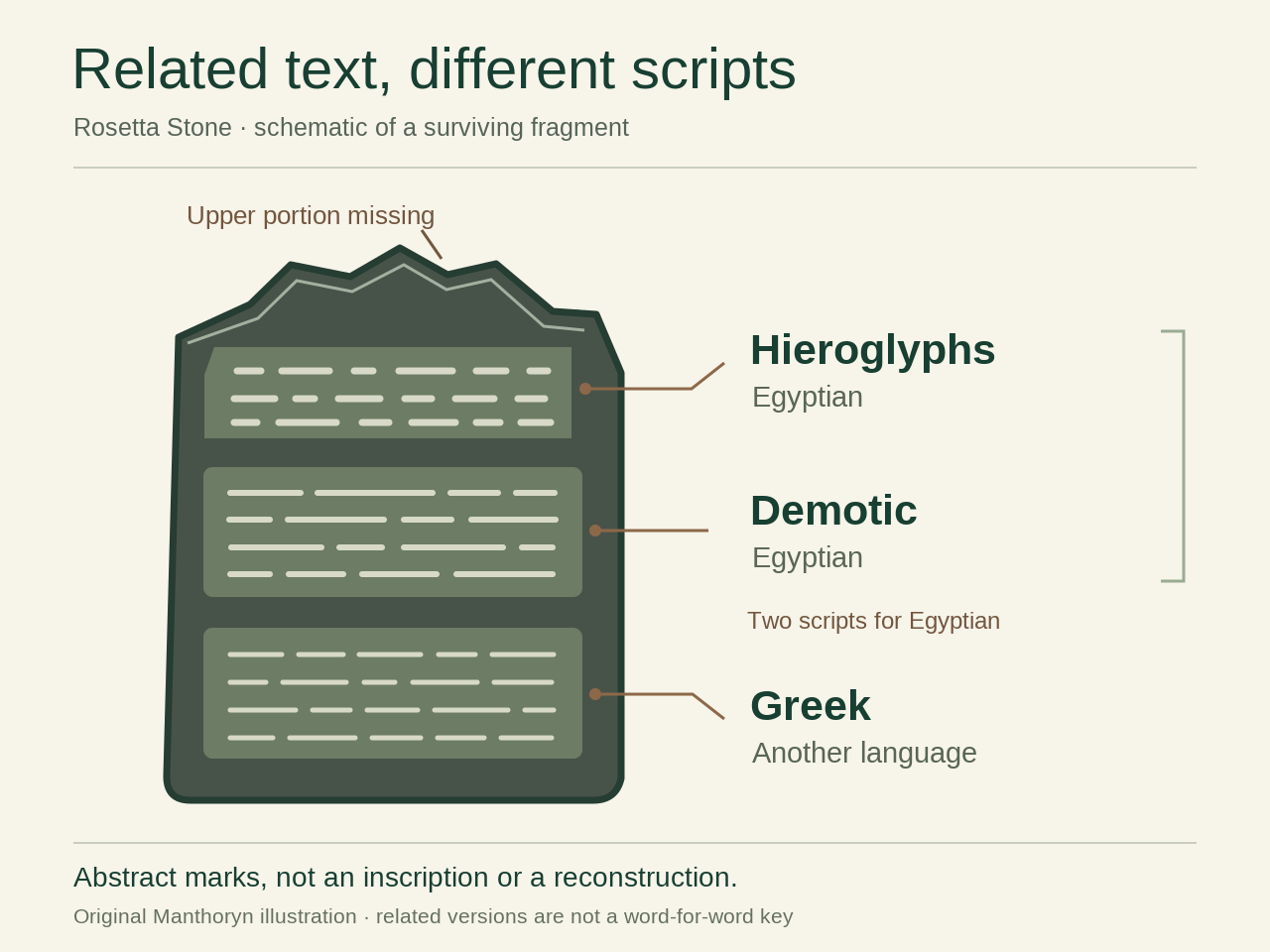
Changes: Original vector artwork, proportionally rasterized to 640px and 1280px WebP. Complete frame retained, no crop or stretching. This is a labelled illustration, not alteration or reconstruction of a documentary photograph.
Rights/source metadata checked 2026-11-17. Images identify the object or work; factual claims rely on the editorial references.
Discovery entry.ce1-rosetta · revision 1.0.0. Raise a content or image concern →. This prepares a local note; no report is delivered.