Football construction
A familiar ball is an agreement between materials and tests.
A football looks like a single round object, but it is assembled from parts with different jobs. A bladder retains air, additional layers support the structure, and an outer cover presents the surface that meets a boot, the ground and water. FIFA’s manufacturing account describes several ways of joining that cover. [1]
How can a ball’s construction influence its behaviour? Its materials and joins must preserve useful shape and performance while the ball is kicked, bounced and exposed to changing conditions. A familiar panel pattern is only the visible entrance to that problem. [2]
← Explore Football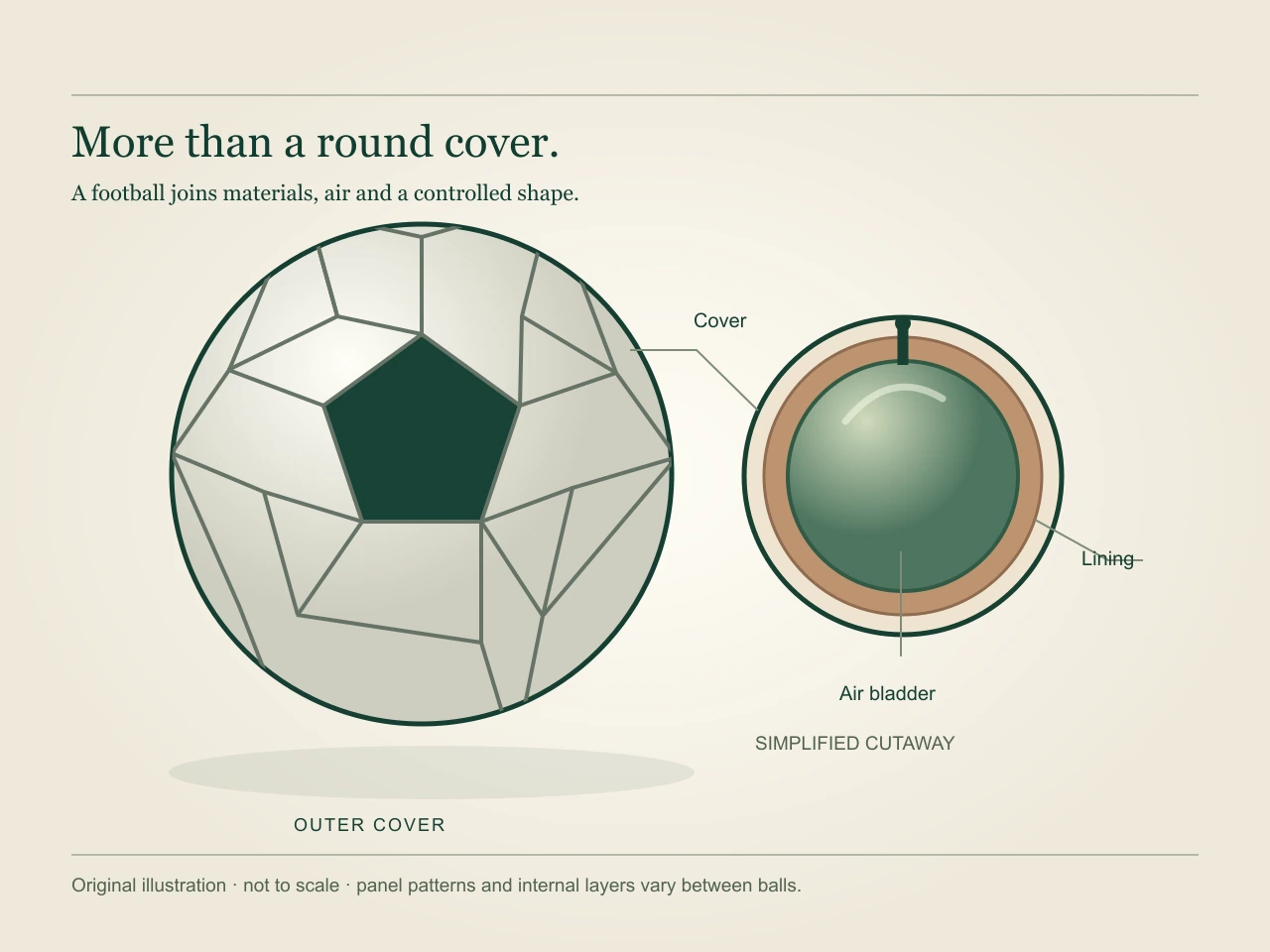
Original educational illustration, not a documentary photograph or a manufacturer’s design. Layers and panel layout are schematic and not to scale.
Manthoryn / Sol, Football construction, 2026. CC BY 4.0. Original SVG with responsive WebP derivatives. CC BY 4.0 ↗ · Image source ↗
A few details change the picture.
Different layers solve different problems
FIFA’s 2018 production account describes latex or butyl bladders, supporting layers and synthetic outer material. The diagram separates these roles rather than reproducing a branded cutaway. Real constructions and the number of layers differ. [1]
A useful comparison is between holding air and protecting a surface. They are not the same requirement. Making one material do everything would still leave a designer with several demands to satisfy: shape, joins, durability and interaction with the surroundings. [1]
A seam is a construction choice
Panels can be joined by hand or machine stitching, by a hybrid approach involving stitching and adhesive, or by thermal bonding in a mould. Those are distinct production routes, not different names for an identical seam. [1]
The lesson is not that one visible panel count predicts every result. To compare two balls fairly, the question must name a property and a test. A drawing of seams cannot by itself tell us the bounce, water uptake or pressure loss of a real ball. [2]
The surface meets the weather
UEFA’s historical account contrasts earlier leather-and-bladder designs with later coatings and bonded constructions. It describes waterproofing as one reason for changes to outer materials. A wet ball is therefore a materials question as well as an inconvenience to a player. [4]
Historical accounts often celebrate a new design, but that does not make every newer ball better in every respect. The informative question is narrower: what was changed, which property was measured and under what conditions? This story claims no universal performance ranking. [4]
Test the object, not the slogan
FIFA’s programme checks multiple properties, including circumference, roundness, mass, bounce, water absorption, loss of pressure and retained shape and size. These tests ask different questions. Passing a measurement of one property does not logically establish all the others. [2]
The IFAB Laws distinguish minimum requirements from additional technical requirements associated with quality marks. A familiar look is not evidence that a particular specimen has been tested or approved. Our unbranded illustration makes no certification claim. [3]
Shared equipment makes comparisons possible
Law 2 specifies a spherical ball, suitable material and bounded size, starting mass and pressure. Defective balls are replaced under defined procedures. The object is part of the conditions of play, not just a prop added after the rules. [3]
Construction matters because the ball must keep doing its job through repeated use. The next time you notice a seam, ask what it joins and which behaviour would need to be measured. That is a more useful route into the design than assuming its pattern alone explains how it plays. [4]
Keep a little curiosity.
Enjoying a discovery is enough. These optional questions may become a deeper investigation.
How do air pressure and a flexible cover interact when a ball is compressed?
A deeper mechanics question for future CEL coverage. The schematic is not a numerical pressure or bounce model.
A complete CEL answer is not published yet.
Plant a Seed for this question →Sources & image notes.
Facts are tied to the references below. This is a source-checked editorial discovery, rather than an assessment or a claim of independent expert review.
- The Making of a Football ↗
FIFA. 2018 account of bladder/lining/cover construction, stitching, hybrid and thermal bonding; no universal claim about all current manufacturers.
Checked 2026-11-17. - FIFA Quality Programme for footballs ↗
FIFA. Tests include circumference, roundness, mass, bounce, water absorption, pressure loss and retained size/shape; programme overview inspected in official indexed text.
Checked 2026-11-17. - Laws of the Game 2026/27 — Law 2: The Ball ↗
The International Football Association Board. Spherical shape, suitable material, match size/mass/pressure and distinctions between minimum Laws and certification; accessed17November2026.
Checked 2026-11-17. - Out of this world: Footballs through time ↗
UEFA. Historical leather/bladder/lacing and later coatings, panel arrangements and bonding; used as a dated history, not an unqualified progress ranking.
Checked 2026-11-17.
Image provenance and modifications
Some collection cards show a labelled detail crop. The full image above retains its source framing.
Illustration
Original educational illustration, not a documentary photograph or a manufacturer’s design. Layers and panel layout are schematic and not to scale.
Manthoryn / Sol, Football construction, 2026. CC BY 4.0. Original SVG with responsive WebP derivatives.
Creator/publisher: Manthoryn / Sol / Manthoryn.
Source record · Original image · Original Manthoryn educational illustration; CC BY 4.0. No third-party image, logo or photographic content.
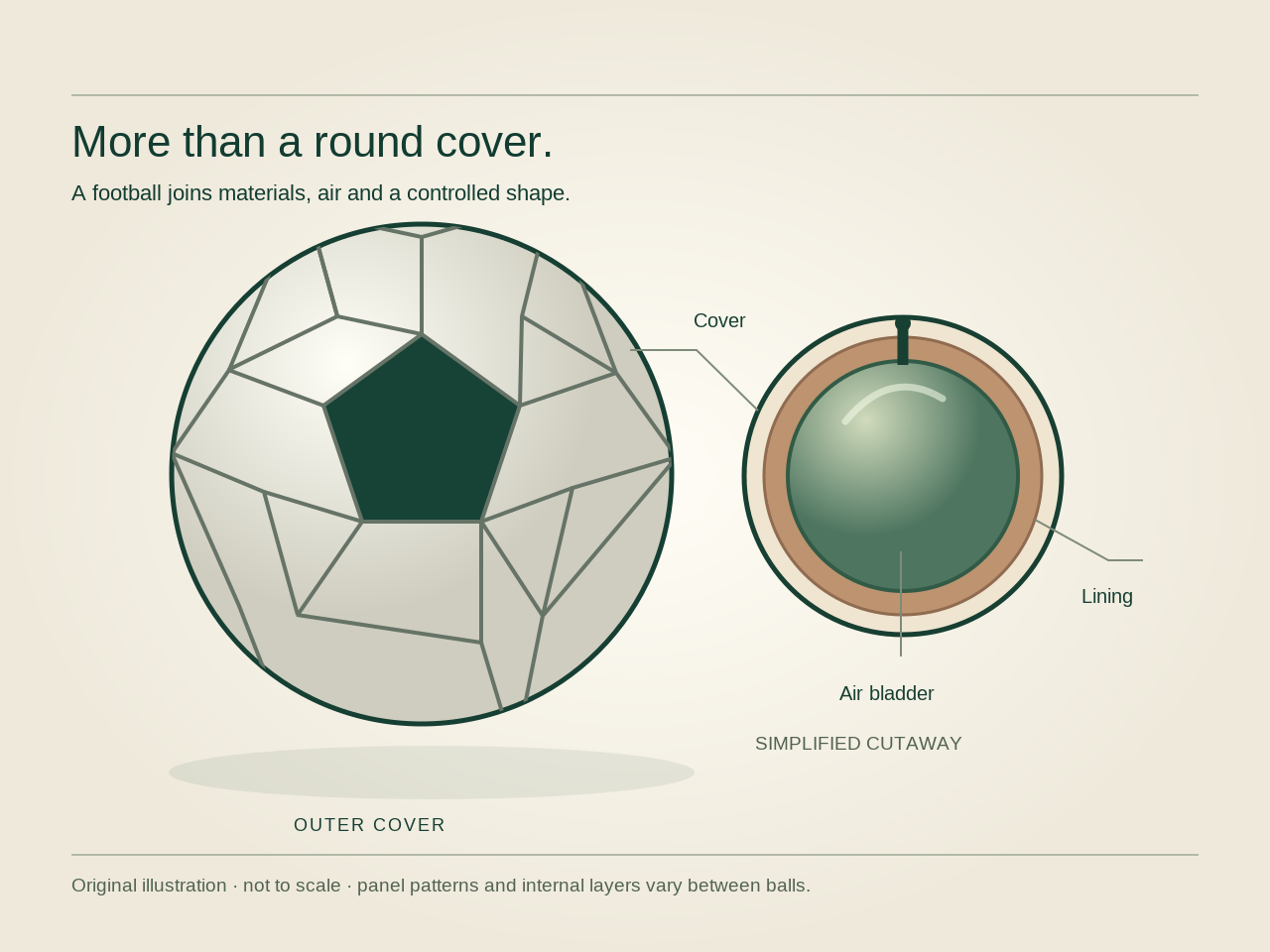
Changes: Original code-authored SVG rendered into responsive WebP files; no photograph or documentary reconstruction. Full composition retained.
Rights/source metadata checked 2026-11-17. Images identify the object or work; factual claims rely on the editorial references.
Discovery entry.ce1-football · revision 1.0.0. Raise a content or image concern →. This prepares a local note; no report is delivered.