A digit classifier: when a familiar example changes
A model can learn a useful clue and still lean on it after it stops working.
A classifier can assign the right digit to an image it has never seen if it learned patterns that transfer from training examples. The same classifier might struggle after a change in framing or image quality. The printed number still means the same thing. The array of pixels reaching the classifier has changed. [1][2]
Consider two invented views of a handwritten eight. One is large and centered on a clean background. The other is smaller and offset. Both still show two closed loops. They are drawn for this explanation, and no model has been run on either. Their purpose is to make a realistic evaluation question visible. [1][2]
← Explore Artificial Intelligence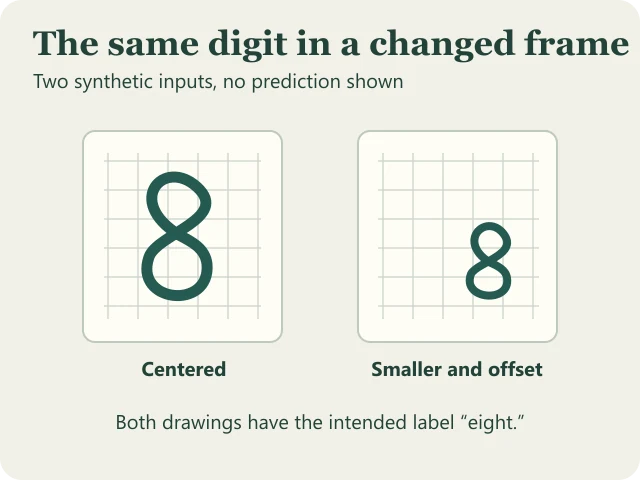
Synthetic illustration of a possible shift in presentation. No dataset images, personal handwriting, experimental outcomes or model output.
Original Manthoryn educational illustration · CC BY 4.0. CC BY 4.0 ↗ · Image source ↗
A few details change the picture.
The model receives a pattern of pixels
A digit image is a grid of brightness values. Training can adjust a model so it assigns higher scores to correct labels on examples with known answers. Some visual features, such as two loop-shaped regions, can travel well across many examples. Other clues, like always finding ink in the center, may depend heavily on how images were collected. [1][2]
Test examples can be new to the model while still sharing the same framing conventions. Good performance there measures a real achievement. Its scope is the test. It does not settle whether recognizing new forms from a different scanner or set of writers will be just as easy. [1][2]
Keep the label and vary the view
The two eight shapes make one reason for a change easy to see. When the loops move in the grid, an observer may still find them. A classifier that relies heavily on exactly where pixels appear can be less reliable. This is a possible failure mechanism, not an assertion about which features any published model used. [1][2]
A distribution shift is a mismatch between the kinds of examples behind a system’s evaluation or training and the kinds that later reach it. It does not require that every changed sample be harder. A carefully defined comparison can test the effect of selected input changes while keeping labels stable. [2]
Decide what would count as evidence
The MNIST-C authors supply versions of test data with different corruptions and evaluate models on them. This lets a reader distinguish a score on an original test from behavior on the altered images. It gives results for the particular models and shifts tested. [2]
To claim our pictured shift matters, we would have to choose a specific model and independent samples, define exactly what changes, then compare results. The two sketched eights are enough to motivate the test. They cannot predict its outcome or show that the classifier understands the symbol as a person does. [1][2]
Keep a little curiosity.
Enjoying a discovery is enough. These optional questions may become a deeper investigation.
How would you test whether changing the background matters more than moving the digit within the frame?
This question asks for a meaningful comparison. The original diagram contains no benchmark samples or measured predictions.
A complete CEL answer is not published yet.
Plant a Seed for this question →Sources & image notes.
Facts are tied to the references below. This is a source-checked editorial discovery, rather than an assessment or a claim of independent expert review.
- Gradient-Based Learning Applied to Document Recognition ↗
Yann LeCun, Léon Bottou, Yoshua Bengio and Patrick Haffner, Proceedings of the IEEE. Historic recognition and standard evaluation with images of handwritten digits.
Checked 2026-11-17. - MNIST-C: A Robustness Benchmark for Computer Vision ↗
Norman Mu and Justin Gilmer, original benchmark paper. Compares recognition under ordinary test conditions and intentionally corrupted digit images. Supports a scoped example of sensitivity to input changes.
Checked 2026-11-17.
Image provenance and modifications
Some collection cards show a labelled detail crop. The full image above retains its source framing.
Illustration
Synthetic illustration of a possible shift in presentation. No dataset images, personal handwriting, experimental outcomes or model output.
Original Manthoryn educational illustration · CC BY 4.0.
Creator/publisher: Original Manthoryn educational illustration / Manthoryn.
Source record · Original image · Original Manthoryn illustration, CC BY 4.0. No third-party image or diagram was reproduced.
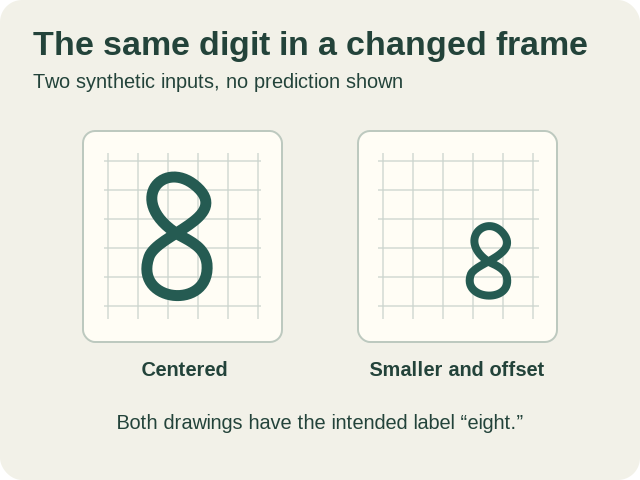
Changes: Original vector artwork rasterized and resized without cropping.
Rights/source metadata checked 2026-11-17. Images identify the object or work; factual claims rely on the editorial references.
Discovery entry.ce3-robots-digit-classifier · revision 1.0.0. Raise a content or image concern →. This prepares a local note; no report is delivered.