The MEMS accelerometer: how a phone senses tilt
The phone turns a tiny shift inside a chip into a direction it can use.
Turn a nearly still phone from upright to sideways. The surroundings have not changed direction. The phone’s own axes have turned relative to them. A sensor inside can pick up a change in which axes register the effect associated with gravity. Software can use that change to decide whether the screen interface should rotate. [2][3]
A motion sensor does not start with labels such as portrait and landscape. It begins with a small physical displacement or another measurable signal. An orientation estimate and an interface decision are separate uses of that signal. [1][3]
← Explore Smartphones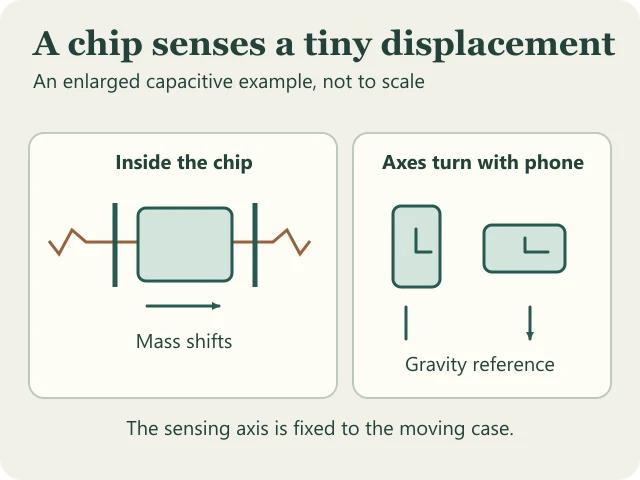
Original conceptual drawing. Neither the chip nor the displacement is to scale.
Original Manthoryn educational illustration · CC BY 4.0. CC BY 4.0 ↗ · Image source ↗
A few details change the picture.
The chip notices motion inside itself
In a representative capacitive design, a small mass can shift relative to the frame holding it. Tiny spring structures resist the movement. Changing gaps between movable and fixed electrodes change their capacitances. Electronics turn a difference in those measurements into a signal related to acceleration along a chosen direction. [1]
Stand the phone at rest on a table and its case is supported against gravity. The sensor can register a signal associated with that support in the phone’s coordinates. Turn the case and the relevant direction changes relative to the chip. The drawing enlarges the movement and leaves out actual micromachined dimensions. [1][2]
More than one event can make a reading change
Slide a phone sideways without changing its angle. While it speeds up or slows down, its accelerometer output can change even though the phone has not tilted. The sensor has no separate field saying how much of one instant’s measurement came from each cause. A stable interval makes interpreting a gravity-related direction easier. [2][3]
A gyroscope supplies rotations as rates around axes. Those rates can help track a quick turn, but small biases can accumulate if integrated over time. Some devices combine motion and other readings to estimate orientation, with exact algorithms depending on the platform and available hardware. [2][3]
Why the display is a software choice
If screen rotation is locked, the phone can still possess working motion sensors. Locking rotation changes how the interface uses estimates, rather than changing which way gravity acts. An app may make a different choice from another app after receiving similar sensor information. [3]
Tilt relative to gravity leaves some questions unanswered. Turning the phone around the vertical while it lies flat can leave the gravity-related readings nearly unchanged. That case needs some other information if the goal is to infer the turn, or to report which way the phone points. [2][3]
Keep a little curiosity.
Enjoying a discovery is enough. These optional questions may become a deeper investigation.
Which phone movement keeps the gravity-related readings nearly unchanged while a gyroscope registers a turn?
An optional follow-up can compare actual device signals. The schematic assumes one capacitive design and does not reconstruct a branded phone.
A complete CEL answer is not published yet.
Plant a Seed for this question →Sources & image notes.
Facts are tied to the references below. This is a source-checked editorial discovery, rather than an assessment or a claim of independent expert review.
- Accelerometer: definition and working principle ↗
Analog Devices. A capacitive MEMS accelerometer uses a moving mass, suspension and electrodes to detect acceleration.
Checked 2026-11-17. - AN-1057: Using an Accelerometer for Inclination Sensing ↗
Christopher J. Fisher, Analog Devices. Tilting changes the projection of gravity on sensor axes. Additional acceleration limits the estimate.
Checked 2026-11-17. - Motion sensors ↗
Android Developers. Distinguishes axes, accelerometer values, gyroscope rotation rate and derived software sensor estimates. Device capabilities vary.
Checked 2026-11-17.
Image provenance and modifications
Some collection cards show a labelled detail crop. The full image above retains its source framing.
Illustration
Original conceptual drawing. Neither the chip nor the displacement is to scale.
Original Manthoryn educational illustration · CC BY 4.0.
Creator/publisher: Original Manthoryn educational illustration / Manthoryn.
Source record · Original image · Original Manthoryn illustration, CC BY 4.0. No third-party image or diagram was reproduced.
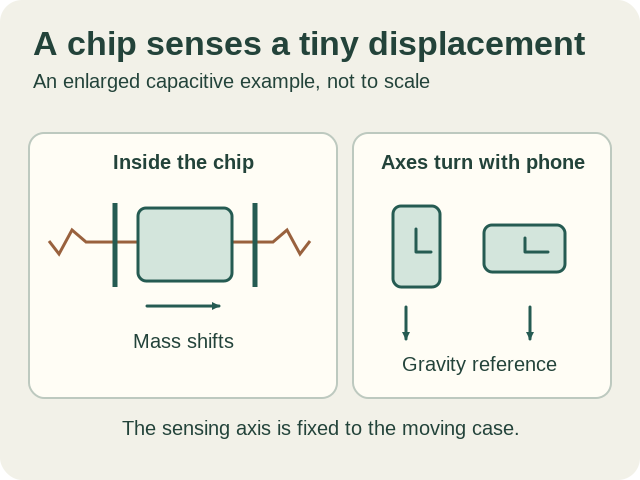
Changes: Original vector artwork rasterized and resized without cropping.
Rights/source metadata checked 2026-11-17. Images identify the object or work; factual claims rely on the editorial references.
Discovery entry.ce3-robots-mems-accelerometer · revision 1.0.0. Raise a content or image concern →. This prepares a local note; no report is delivered.