Volta’s pile: a stack that could keep current flowing
A wire carries charge around a circuit because processes within the source sustain a difference.
A brief spark tells you that charge moved. It does not provide a source that keeps transferring energy to a circuit. Alessandro Volta’s 1800 communication described a layered electrical source. The pile made current available for more sustained observation. The Smithsonian records a surviving example from 1805, several years after the letter. [1][2]
The historic device raises a question we can answer with a modern model. What has to keep happening inside a source so that charge keeps moving around a closed circuit? The answer involves both chemical change and physically different carriers in different materials. [2][3]
← Explore Electronics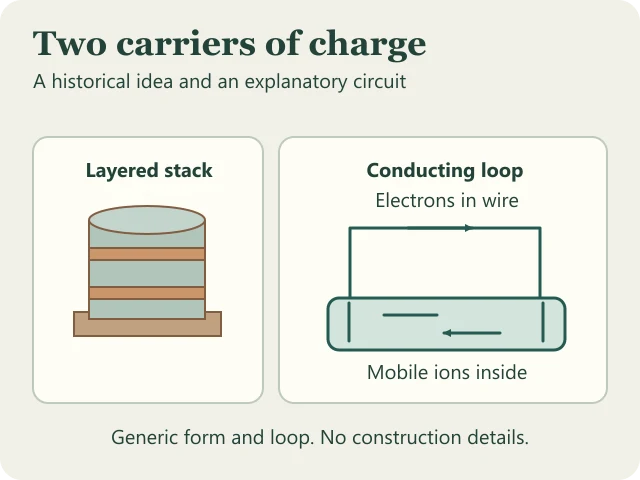
Original electrochemical model. The pile silhouette is generic and the schematic shows no assembly or experimental procedure.
Original Manthoryn educational illustration · CC BY 4.0. CC BY 4.0 ↗ · Image source ↗
A few details change the picture.
A voltaic source can maintain a potential difference while chemical processes continue and a conducting loop is available. [3]
Mobile electrons carry charge in a metal wire. In an electrolyte, mobile ions carry charge. The current describes charge flow without assuming identical carriers everywhere. [3]
Keep voltage distinct from charge flow
The ends of a working source can have a difference in electric potential when the external path is open. With the external circuit broken, it cannot sustain current through that break. Closing the path allows moving charges to transfer energy through the circuit. An open source can have voltage without the same through-current. [3]
The pile arranged multiple cells so their electrical effects could combine. The historic object shows repetition of layers, but seeing the stack alone cannot explain how the charges stay mobile. For that, follow the processes at the interfaces and the two kinds of conducting path. [2][3]
Each part of the circuit has its carriers
At one electrode, a chemical process releases electrons into the metal, and a process at the other electrode takes up electrons. The outside connection can then carry electrons between electrodes. Inside a working cell, some ions in the electrolyte move. Their movement helps balance charge as reactions continue near the solid surfaces. [3]
That lets a circuit transfer energy without using up charge. The chemical ingredients can change, reaction products can accumulate, and the device can stop supplying useful energy. Those changes differ from making charge disappear at a device powered by the source. [3]
What the historic stack can actually show
Look at the labeled illustration and compare a stack of several units with the abstract view of the conducting loop. The stack is the historical idea. The loop is a model of how an operating electrochemical system keeps charge moving. It omits the exact reactions of the old pile and shows no construction dimensions or procedure. [1][2][3]
A museum example gives evidence for the object’s materials, date and form. A modern source model explains why the effects cannot go on unchanged indefinitely. The distinction matters because Volta’s historical interpretation and today’s account of electrode reactions belong to different questions. [1][2][3]
Keep a little curiosity.
Enjoying a discovery is enough. These optional questions may become a deeper investigation.
What measurements could tell how a source’s voltage changes as it supplies current over time?
A useful follow-up would distinguish potential and current over a measured interval. The historic stack is discussed as an object, not as a construction project.
A complete CEL answer is not published yet.
Plant a Seed for this question →What exactly is counted when a current flows?
The existing Current lesson explains charge per time at a chosen boundary and distinguishes charge from energy.
The circuit model in the discovery uses current as a rate of charge crossing a boundary.
Scope: The lesson does not explain Volta’s electrode reactions or predict a historic pile’s output.
What carries charge inside each part of the circuit?
The existing Charge Carriers lesson compares the mobile charges in a metal and a solution.
The two conducting parts of an electrochemical circuit use different mobile carriers.
Scope: The lesson describes mobility and charge carriers, without modeling the historical cell or its electrode reactions.
Sources & image notes.
Facts are tied to the references below. This is a source-checked editorial discovery, rather than an assessment or a claim of independent expert review.
- Account of electricity excited by contact and conducting substances of different kinds ↗
The Royal Society archive, Alessandro Volta to Joseph Banks. Dates Volta’s communication to March 20, 1800 and identifies its subject.
Checked 2026-11-17. - Battery: Voltaic Pile ↗
Smithsonian National Museum of American History. Documents a surviving early voltaic pile dated 1805 and identifies its layered materials.
Checked 2026-11-17. - Chemistry 2e §17.2: Galvanic Cells ↗
OpenStax, Rice University. Modern account of oxidation, reduction, electron transfer through an external conductor, and ionic motion inside a working electrochemical cell.
Checked 2026-11-17.
Image provenance and modifications
Some collection cards show a labelled detail crop. The full image above retains its source framing.
Illustration
Original electrochemical model. The pile silhouette is generic and the schematic shows no assembly or experimental procedure.
Original Manthoryn educational illustration · CC BY 4.0.
Creator/publisher: Original Manthoryn educational illustration / Manthoryn.
Source record · Original image · Original Manthoryn illustration, CC BY 4.0. No third-party image or diagram was reproduced.
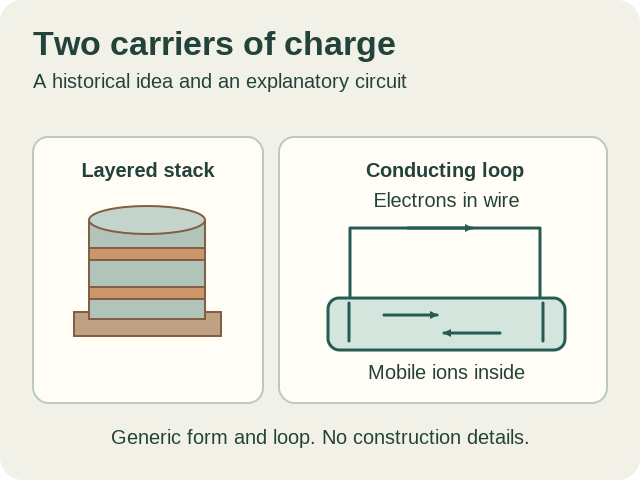
Changes: Original vector artwork rasterized and resized without cropping.
Rights/source metadata checked 2026-11-17. Images identify the object or work; factual claims rely on the editorial references.
Discovery entry.ce3-robots-voltas-pile · revision 1.0.0. Raise a content or image concern →. This prepares a local note; no report is delivered.