WABOT-1: when seeing, standing and reaching meet
A hand can reach a known point only while the body keeps the point within reach.
If a humanoid notices an object just outside its reach, moving toward it changes several things at once. The legs must support a body in motion. The target moves relative to the eyes and hands even when it remains still on a table. Then a hand has to close around the object without losing its hold. WABOT-1, completed at Waseda University in 1973, brought versions of these problems together in one machine. [1][3]
Use an imagined object to follow the coordination. The historical reports describe kinds of capability such as walking, finding an object and using the hands. The imaginary table in this discovery explains the dependencies among those jobs. It does not reconstruct a particular WABOT demonstration. [1][2]
← Explore Humanoid Robots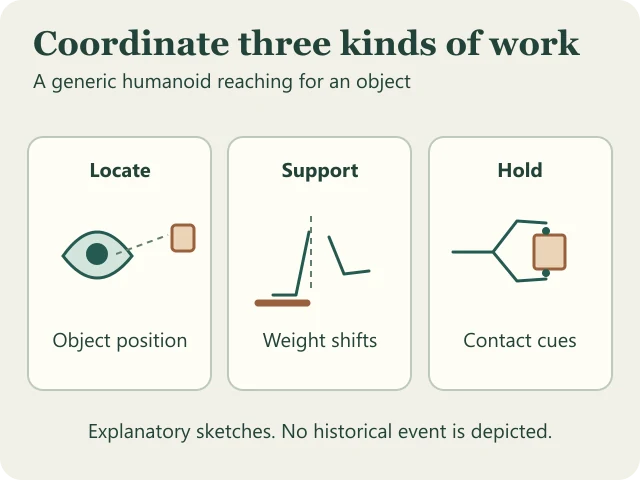
Conceptual drawing of coordination. Generic shapes depict no WABOT-1 components or archival event.
Original Manthoryn educational illustration · CC BY 4.0. CC BY 4.0 ↗ · Image source ↗
A few details change the picture.
Locate the object again after a step
A useful direction depends on where the robot is and what part of it will move. A visual system may supply a direction and distance relative to a camera. The arm needs to move relative to its own joints. If the torso turns in the meantime, an old target direction no longer points from the same place. The first form of coordination is keeping those descriptions of position in agreement. [1][2]
In the imaginary tabletop scene, seeing the object first guides how to approach it. When the body stops closer, the relevant movement is now a shorter reach from a new position. In a constrained demonstration the table, object and starting position can make parts of the problem simpler. A success under those conditions establishes only what the setup tested. [1][2]
Standing and reaching share a body
Imagine shifting most of the weight to one foot before moving the other. As long as the supporting foot remains planted, the next movement must keep the body supported. Slowly moving one limb changes where the mass is distributed, even if the limb is only an arm. A reach that seems easy when seated introduces another balance problem when the body stands on two legs. [2]
Quasi-static movement aims to keep the machine close to equilibrium at each stage. In a different style of gait momentum matters more. Calling both of those modes walking says little about which constraints their controllers have to manage or how their timing works. [2]
Contact supplies information vision can miss
A target position can guide a hand toward the object. After contact, the hand needs evidence about whether anything is actually between its fingers and whether the grip can hold. Waseda records hands with tactile sensing. Touch and sight can describe the same encounter at different stages without measuring the same quantity. [1]
A voice system may receive a simple request. That does not show it can understand every request, locate every object or find its own method on an unfamiliar surface. The historic accomplishment lies in combining several constrained functions in one embodied system. [1][3][2]
Keep a little curiosity.
Enjoying a discovery is enough. These optional questions may become a deeper investigation.
What would you measure to tell whether an inaccurate reach came from vision or from movement of the torso?
A future mechanism lesson could use a carefully defined reach test. The historical record does not give performance for arbitrary settings.
A complete CEL answer is not published yet.
Plant a Seed for this question →Another story to explore.
Editorial suggestions for browsing, with the reason shown. These are not canonical knowledge-graph relationships.
Sources & image notes.
Facts are tied to the references below. This is a source-checked editorial discovery, rather than an assessment or a claim of independent expert review.
- Waseda’s Robot Research History: WABOT-1 ↗
Waseda University. WABOT-1 completion in 1973, limb control, vision, touch and simple conversation.
Checked 2026-11-17. - Humanoid Robotics, historical overview ↗
Eiichi Yoshida, AIST. Identifies quasi-static walking and the combination of recognizing and manipulating an object.
Checked 2026-11-17. - Waseda Robotics Research Leading the World ↗
Waseda Global Research Center. Identifies the cross-disciplinary WABOT project led by Ichiro Kato and differentiates WABOT-1 from later models.
Checked 2026-11-17.
Image provenance and modifications
Some collection cards show a labelled detail crop. The full image above retains its source framing.
Illustration
Conceptual drawing of coordination. Generic shapes depict no WABOT-1 components or archival event.
Original Manthoryn educational illustration · CC BY 4.0.
Creator/publisher: Original Manthoryn educational illustration / Manthoryn.
Source record · Original image · Original Manthoryn illustration, CC BY 4.0. No third-party image or diagram was reproduced.

Changes: Original vector artwork rasterized and resized without cropping.
Rights/source metadata checked 2026-11-17. Images identify the object or work; factual claims rely on the editorial references.
Discovery entry.ce3-robots-wabot-1 · revision 1.0.0. Raise a content or image concern →. This prepares a local note; no report is delivered.