How fingerprint scanners recognize your finger
From ridges on skin to a digital comparison, and why a familiar finger may not be recognized.
A fingertip has a landscape of raised ridges and lower valleys. A scanner measures a sample of that landscape, then software compares selected features with a reference made when the finger was enrolled. Each stage can succeed or fail independently. After death, the ridge pattern can persist even when changes to the skin make a useful reading harder to obtain. [5]
Follow the learning connection ↓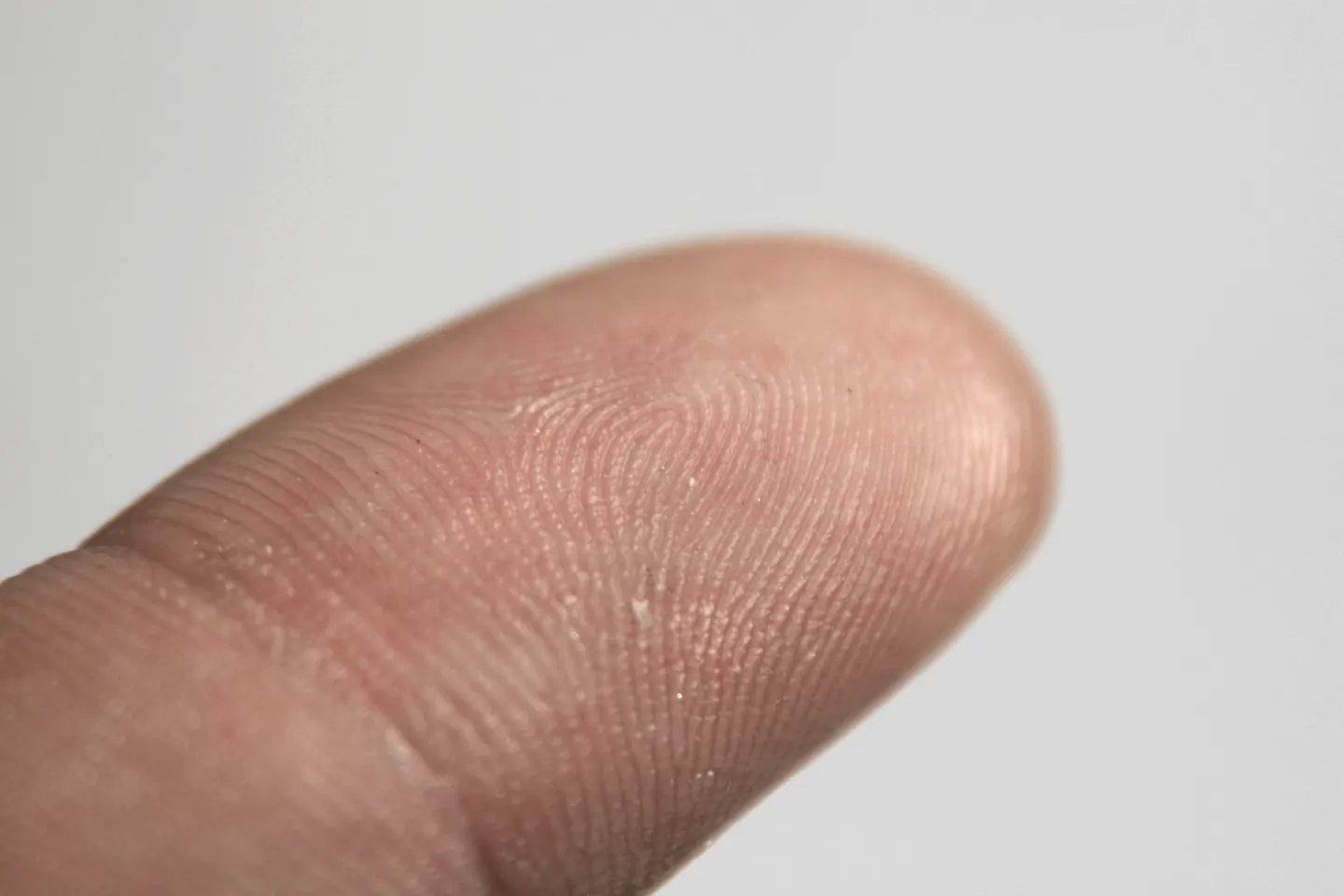
A close-up of a fingertip shows the ridges and valleys that form a fingerprint.
Zephyris, via Wikimedia Commons, CC BY-SA 3.0 Image rights ↗ · Image source ↗
A few details change the picture.
A pattern that begins before birth
Friction ridges form on the fingertips during development before birth. Their raised paths curve, end and branch, while valleys lie between them. Broad patterns help describe a print, but the relative positions of local ridge endings and forks provide much finer detail for comparison. The fingerprint is a physical pattern on skin, not a digital code. [2]
Turning ridges into a measurement
Imagine one ridge crossing a small patch of the sensor. An optical reader uses differences in light to capture ridge detail. A capacitive reader detects electrical differences associated with contact and separation between the skin and the sensor. An ultrasonic reader uses high-frequency sound and its interaction with the finger. These are different measurements of the same physical surface, each with its own design and limitations. [3]
From a sample to a decision
During enrollment, a device captures samples and derives a reference representation. Later it captures another sample and compares selected features against that reference. The device does not need two images to be pixel-for-pixel identical. It evaluates how well the information agrees under its matching rules, then applies a decision threshold. Apple describes this process for Touch ID as one implementation. [6]
Why a familiar finger can be rejected
Return to our small ridge patch. If the finger is shifted, pressed differently, wet, dry, injured or only partly captured, the new measurement may contain less comparable detail. A matcher may also reject a genuine sample when its score falls below the decision threshold. A rejection therefore tells us the system did not accept that attempt. It does not, by itself, show that the person has a different fingerprint. [4]
What changes after death
Fingerprint ridges do not simply disappear at death. Their condition can change, however, and forensic guidance notes that the varying condition of postmortem skin can make collecting usable ridge detail difficult. Changes in moisture, shape or tissue condition can affect the contact and contrast a particular sensor receives. The outcome depends on the finger, the sensor, timing and circumstances. Forensic recovery of a print and acceptance by a specific device are different questions. [5]
Matching and liveness are separate checks
Matching asks whether a sample resembles an enrolled reference closely enough. Presentation attack detection is a separate set of techniques intended to help detect fraudulent presentations. Its presence and behavior depend on the system. Neither a successful match nor a failed scan alone establishes whether a person is alive. This distinction keeps the explanation from treating every fingerprint reader as if it used the same sensor or checks. [4]
Questions this story opens
How can numbers represent a digital picture?
Explore how digital images can represent sampled information, then return to the fingerprint discovery.
This explanation introduces how numerical values can represent picture information, a useful foundation for understanding digital sensor images.
Scope: The explanation does not teach fingerprint sensors, feature extraction, template security, or biometric matching.
Sources & image notes.
Facts are tied to the references below. This is a source-checked editorial discovery, rather than an assessment or a claim of independent expert review.
- Fingerprint Sourcebook: Anatomy and Physiology of Adult Friction Ridge Skin ↗
National Institute of Justice. Friction ridge skin structure and anatomy.
Checked 2026-11-26. - Fingerprint Sourcebook: Embryology, Physiology, and Morphology ↗
National Institute of Justice. Sourcebook describes formation and morphology of friction ridge skin.
Checked 2026-11-26. - Fingerprint sensor technologies ↗
National Institute of Standards and Technology. Definitions of optical, capacitive and ultrasonic fingerprint acquisition technologies.
Checked 2026-11-26. - Digital Identity Guidelines: Authentication and Authenticator Management ↗
National Institute of Standards and Technology. Biometric comparison, error rates and presentation attack detection.
Checked 2026-11-26. - Recording Living and Postmortem Friction Ridge Skin Exemplars ↗
National Institute of Justice. Condition of friction ridge skin can complicate recording after death.
Checked 2026-11-26. - About Touch ID advanced security technology ↗
Apple. Example of a device comparing an enrolled fingerprint representation with later scans.
Checked 2026-11-26.
Image provenance and modifications
Some collection cards show a labelled detail crop. The full image above retains its source framing.
Photograph
A close-up of a fingertip shows the ridges and valleys that form a fingerprint.
Zephyris, via Wikimedia Commons, CC BY-SA 3.0
Creator/publisher: Zephyris / Wikimedia Commons.
Source record · Original image · Creative Commons Attribution-ShareAlike 3.0 Unported. Attribution required. Adaptations shared under the same license.


Changes: Original uploaded without alteration. Display crops are nondestructive and must be disclosed if used.
Rights/source metadata checked 2026-11-26. Images identify the object or work; factual claims rely on the editorial references.
Discovery entry.authored-6fea451e-c2d7-4cd6-8643-571787a9cea3 · revision 1.0.0. Raise a content or image concern →. This prepares a local note; no report is delivered.