MIT Cheetah 2: what a bound borrows
Copying a stride begins with the order and duration of ground contact.
When a leg lifts, its foot can be repositioned. When it touches down, the ground can support and redirect the body. The MIT Cheetah 2 research uses these distinct phases to ask how a machine can repeat a bound. The animal name hints at the design question. The experiment studied selected properties of motion in a machine. [1][2]
The useful comparison is a sequence of contacts and loads. A living cheetah also chooses when to turn, slow down and accelerate on irregular ground. Similarities in one model of leg movement do not show that both systems use the same anatomy or strategies. [1][3]
← Explore Robot Animals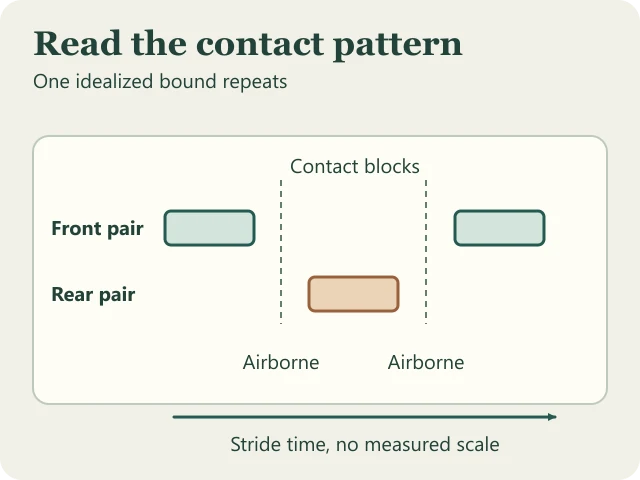
Original idealized bounding timeline. Neither the robot nor wild cheetah contact times are plotted.
Original Manthoryn educational illustration · CC BY 4.0. CC BY 4.0 ↗ · Image source ↗
A few details change the picture.
Follow the feet rather than the silhouette
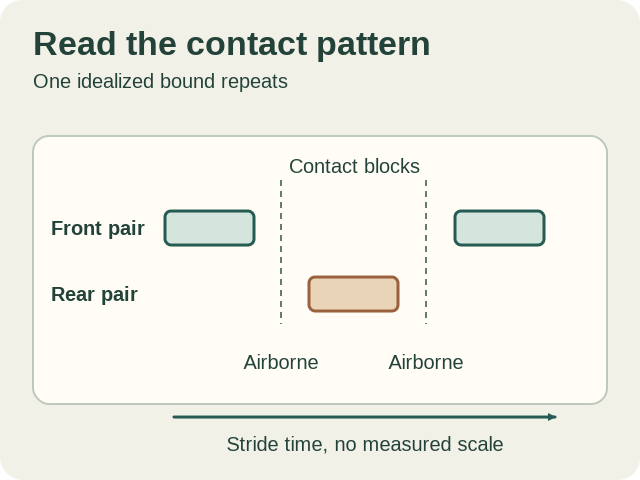
Take a side-by-side timeline of four named legs. In the simplified bound, the two front feet contact together. Later the rear pair contacts together. Empty portions on both rows show moments when neither pair touches. If you change which feet land together, you change the gait pattern even if the robot’s body outline stays the same. [1][2]
Track one row over a whole repeat. The fraction filled by its contact interval is that pair’s duty cycle. Our graphic has ordinary horizontal spacing for easy comparison. It gives no measured timing and does not represent a wild cheetah footfall recording. [1][2]
Support arrives during contact
A foot in the air cannot drive against the ground. A loaded foot can receive an upward push from the ground. Imagine two similar steady strides, one with less time in contact. Over the whole cycle, support still matters. The shorter contact makes what happens during that interval especially important. [1]
The MIT study treats the effect of force over the contact time as part of its explanatory model. A mechanical design then has to deliver those interactions without simply replacing animal muscles and tendons with visually similar parts. The control details and drawings in the papers describe a specific research machine. [1][2]
An animal also chooses a path
An independent study of wild cheetahs used tracking collars to measure speed changes and turning during runs. Those records concern whole-animal behavior in a setting with no fixed laboratory course. They cannot be read as tests of the robot’s gait controller. [3]
The useful borrowing is limited. Researchers can describe support, timing and force with terms that apply to both systems. Comparison becomes sharper when it says which of those properties was engineered, which was observed in the animal, and which has not been compared directly. [1][3]
Keep a little curiosity.
Enjoying a discovery is enough. These optional questions may become a deeper investigation.
Which observations would distinguish a change of gait from the same gait performed at a different speed?
Future reading can compare recorded footfall patterns and contact timing. This schematic gives no controller settings or mechanical construction details.
A complete CEL answer is not published yet.
Plant a Seed for this question →Sources & image notes.
Facts are tied to the references below. This is a source-checked editorial discovery, rather than an assessment or a claim of independent expert review.
- Quadruped Bounding Control with Variable Duty Cycle via Vertical Impulse Scaling ↗
Hae-Won Park, Meng Yee Chuah and Sangbae Kim, MIT research archive. Identifies Cheetah 2, bounding, duty cycle and measured laboratory capability.
Checked 2026-11-17. - High-speed bounding with the MIT Cheetah 2: Control design and experiments ↗
Park, Wensing and Kim, International Journal of Robotics Research. Describes contact force, patterns and experimental scope for one version of the robot.
Checked 2026-11-17. - Locomotion dynamics of hunting in wild cheetahs ↗
Alan Wilson and colleagues, Nature. Field study documents variable speed and changes of direction in tracked wild cheetahs. It is independent of the MIT experiments.
Checked 2026-11-17.
Image provenance and modifications
Some collection cards show a labelled detail crop. The full image above retains its source framing.
Illustration
Original idealized bounding timeline. Neither the robot nor wild cheetah contact times are plotted.
Original Manthoryn educational illustration · CC BY 4.0.
Creator/publisher: Original Manthoryn educational illustration / Manthoryn.
Source record · Original image · Original Manthoryn illustration, CC BY 4.0. No third-party image or diagram was reproduced.
Changes: Original vector artwork rasterized and resized without cropping.
Rights/source metadata checked 2026-11-17. Images identify the object or work; factual claims rely on the editorial references.
Discovery entry.ce3-robots-mit-cheetah · revision 1.0.0. Raise a content or image concern →. This prepares a local note; no report is delivered.