The Fosbury flop changed what passes over the bar
Different parts of a jumper can clear the bar at different moments.
A high jumper has to get the body past a bar without sending it to the ground. The highest point of the body and the highest point of its centre of mass are different. The centre of mass is an average position weighted by where body mass is located. It is useful precisely because it does not belong to one named body part. [2]
Dick Fosbury’s Olympic win in Mexico City in 1968 made a backward, arched style famous. The change also belongs to a period of other experiments and new landing equipment, which let athletes consider body paths that earlier landing surfaces had discouraged. [1][3]
← Explore Athletics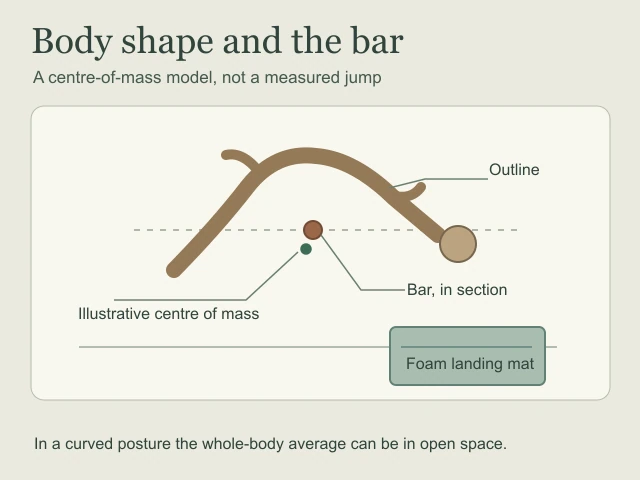
Idealized high-jump geometry. The silhouette and centre-of-mass marker are illustrative, with no measured athlete path or training sequence.
Original Manthoryn educational illustration · CC BY 4.0. CC BY 4.0 ↗ · Image source ↗
A few details change the picture.
Compare the athlete with one moving point
A model can keep track of a single position for the whole body while still recognizing that the body has a shape. Arms, legs and torso can lie on different sides of that average position. Changing their positions changes how the body is arranged around that point. [2]
What can a curve around a bar show?
In a sufficiently curved idealized arrangement, the average position can lie in open space below some raised body parts. Different parts can cross the bar at different times. The picture shows why the whole-body average need not follow the same arc as the top of the back. It does not measure the position reached in Fosbury’s jump. [2][1]
Changing shape is not another push off the ground
In the simple flight model, gravity controls the path of the overall centre of mass after takeoff, ignoring air resistance. Moving a segment can change body orientation and which pieces are near the bar without providing another push from the ground. That is why motion at takeoff and shape in flight belong in the same explanation. [2]
A record belongs to equipment and people
Fosbury did not invent the foam landing bed or make every later jumper identical. The historical record gives a particular achievement. Changes to the landing surface and experiments by other competitors help explain why the era accommodated different body paths. [1][3]
Keep a little curiosity.
Enjoying a discovery is enough. These optional questions may become a deeper investigation.
Why is a dot representing the whole body different from a mark on one shoulder?
This question is about a centre-of-mass model. It provides no instruction for attempting or practising a high jump.
A complete CEL answer is not published yet.
Plant a Seed for this question →Sources & image notes.
Facts are tied to the references below. This is a source-checked editorial discovery, rather than an assessment or a claim of independent expert review.
- 50 years since the day Dick Fosbury revolutionised the high jump ↗
World Athletics Heritage. 1968 example, preceding experimentation by Fosbury and others, and change to foam landing beds.
Checked 2026-11-17. - Biomechanical analysis of the high jump at the 2005 IAAF World Championships ↗
New Studies in Athletics, World Athletics archive. Uses body-segment model and centre of mass, separates motion after takeoff and individual performances.
Checked 2026-11-17. - High jump pioneer Fosbury dies ↗
World Athletics. Historical competition and acknowledged influence of Fosbury’s high-jump variation.
Checked 2026-11-17.
Image provenance and modifications
Some collection cards show a labelled detail crop. The full image above retains its source framing.
Illustration
Idealized high-jump geometry. The silhouette and centre-of-mass marker are illustrative, with no measured athlete path or training sequence.
Original Manthoryn educational illustration · CC BY 4.0.
Creator/publisher: Original Manthoryn educational illustration / Manthoryn.
Source record · Original image · Original Manthoryn educational illustration, CC BY 4.0. No photograph, brand artwork, athlete likeness or proprietary diagram reproduced.
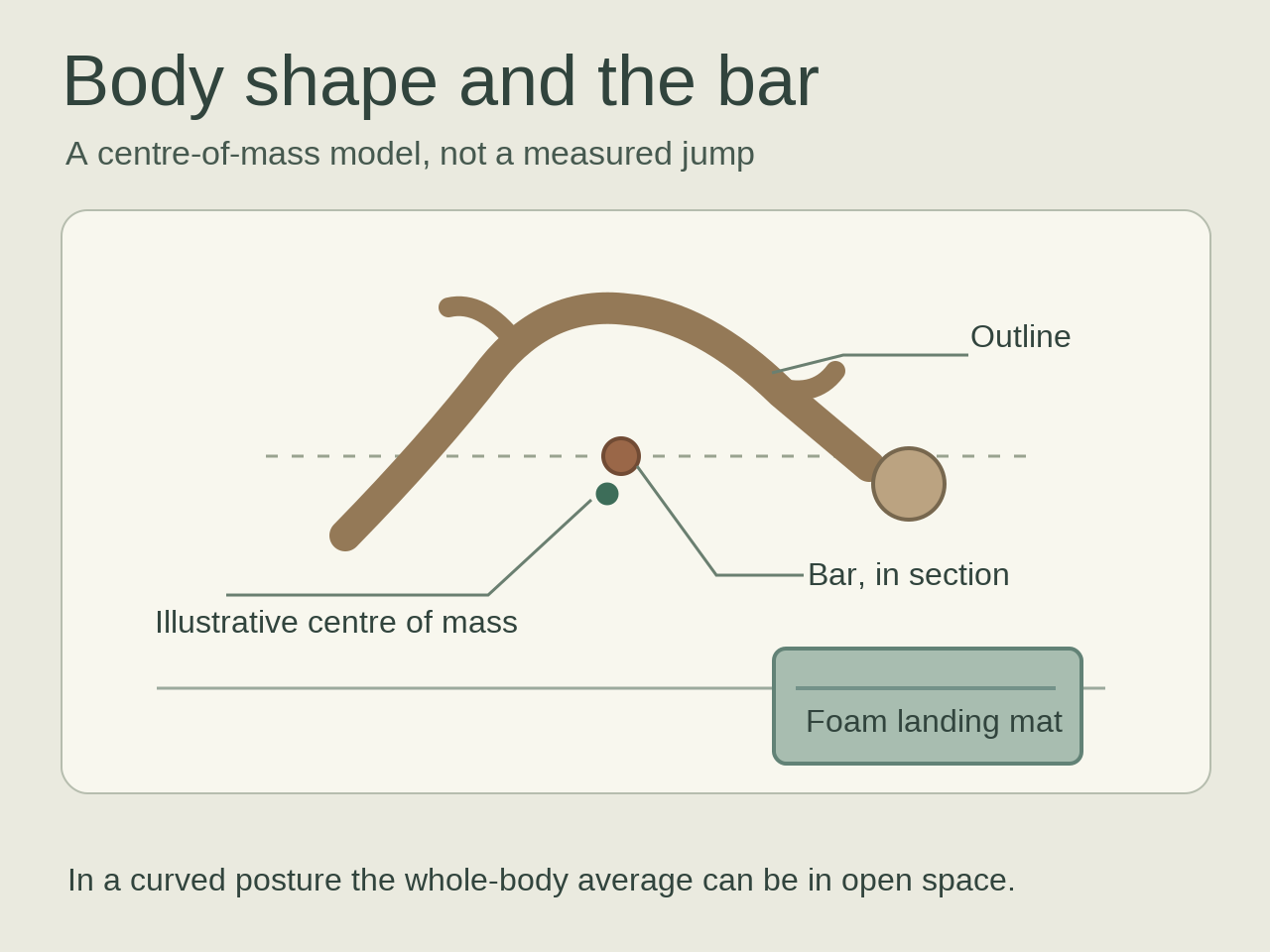
Changes: Original labelled SVG rasterized to two WebP widths without cropping.
Rights/source metadata checked 2026-11-17. Images identify the object or work; factual claims rely on the editorial references.
Discovery entry.ce3-sports-fosbury-flop · revision 1.0.0. Raise a content or image concern →. This prepares a local note; no report is delivered.