The basketball backboard changes the ball’s path
A second path to the hoop appears when a solid surface sends the ball in a different direction.
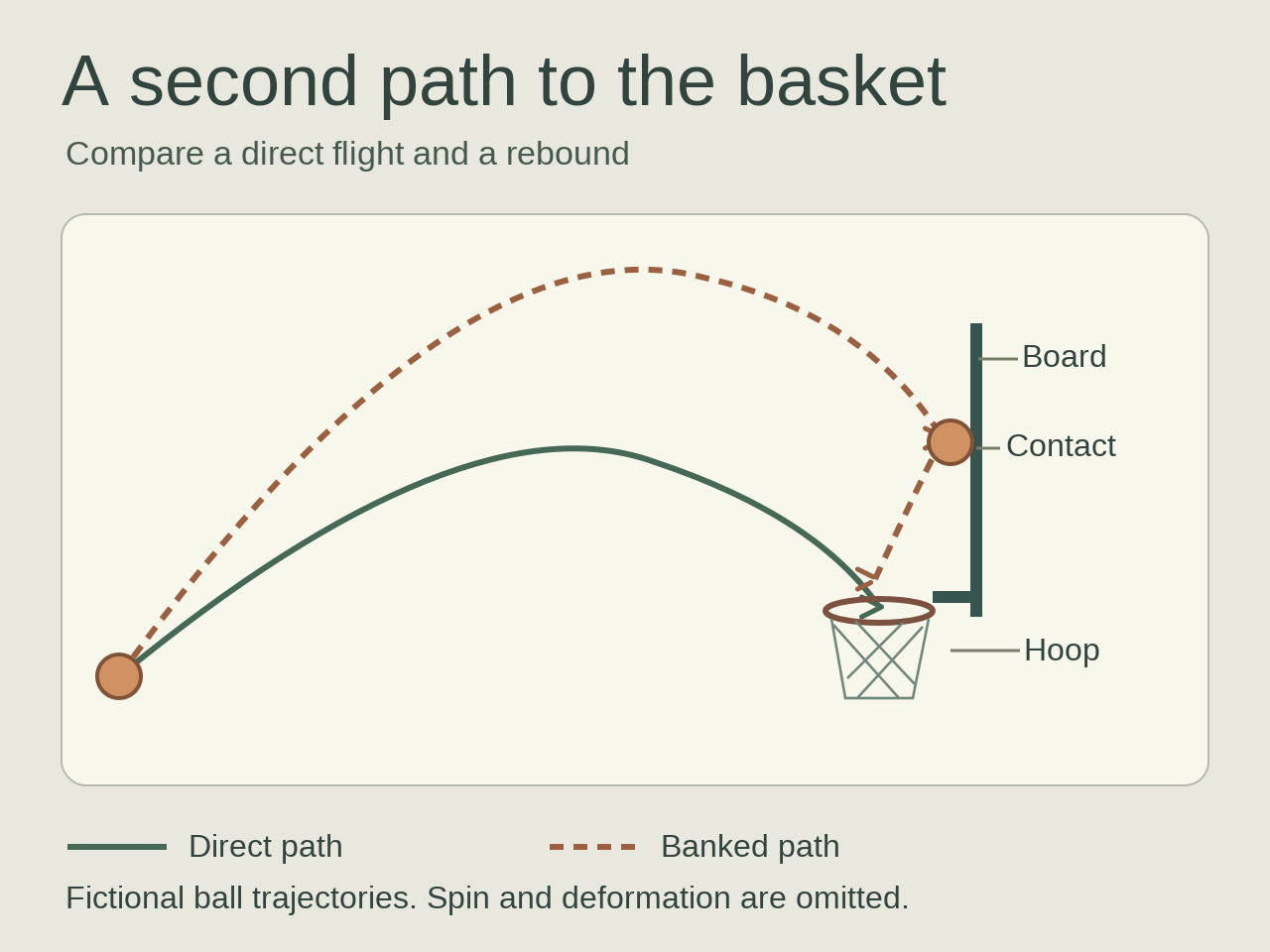
The hoop could be the target in either of two pictures. In one, the ball travels to it directly. In the other, the ball flies past the hoop, touches a backboard and turns back. The added surface changes what paths are physically possible. [1][3]
James Naismith’s historical account describes adding a backstop to early basketball. A barrier also separated part of the play from spectators behind the basket. That equipment change came to matter for play as well as for the arrangement of the space. [2][1]
← Explore Basketball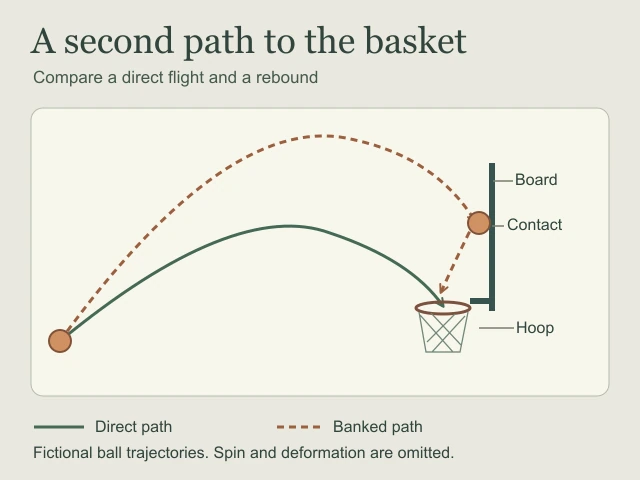
Illustrative basketball trajectories. The curves and outcomes are invented to show a change of direction, with no shot or coaching recommendation.
Original Manthoryn educational illustration · CC BY 4.0. CC BY 4.0 ↗ · Image source ↗
A few details change the picture.
Follow the ball before it hits
Once the ball leaves the player, its path curves under gravity. In the drawing, the banked route encounters a solid board before the ball has fallen through the rim. If the board were missing, the same initial motion would carry the ball past the hoop rather than turn it back. [3][2]
Contact changes one part of the motion strongly
The board pushes back on the ball while the ball and surface momentarily deform. A simple model separates motion toward the board from motion along it. The component directed into the board can reverse, with some of its motion lost during rebound. Friction can also change the component along the board and interact with spin. [3]
Separate possible paths from guaranteed paths
One drawn path ends at the hoop, but another initial angle or rebound might miss. The board lets a new kind of route exist. The existence of that route says little about a real player’s chances without knowing launch conditions, spin and impact behavior. [2][3]
A passage from boundary to equipment
The historical backstop had a role in how spectators and play were separated. Its present mechanical role is understandable without treating that reason as the original purpose of every board. An object can change a game in ways its first users were trying to solve and in ways they could discover afterward. [1][2]
Keep a little curiosity.
Enjoying a discovery is enough. These optional questions may become a deeper investigation.
What would you compare to tell whether a softer rebound changes the ball’s path after contact?
The figure omits spin, deformation and real launch conditions. It poses a model-testing question, without promising a shot outcome.
A complete CEL answer is not published yet.
Plant a Seed for this question →Sources & image notes.
Facts are tied to the references below. This is a source-checked editorial discovery, rather than an assessment or a claim of independent expert review.
- Basketball ↗
Smithsonian National Postal Museum. Naismith's 1891 invention and the use of early baskets.
Checked 2026-11-17. - Basketball: Its Origin and Development, pp. 93–95 ↗
James Naismith, historical text. Backstop introduced in the nineteenth-century rules, its relationship to spectator access and later board materials.
Checked 2026-11-17. - The bounce of a ball ↗
Rod Cross, American Journal of Physics, 1999. Experiments on deformation and energy loss during rebounds of several ball materials. No basketball-specific measurement adopted.
Checked 2026-11-17.
Image provenance and modifications
Some collection cards show a labelled detail crop. The full image above retains its source framing.
Illustration
Illustrative basketball trajectories. The curves and outcomes are invented to show a change of direction, with no shot or coaching recommendation.
Original Manthoryn educational illustration · CC BY 4.0.
Creator/publisher: Original Manthoryn educational illustration / Manthoryn.
Source record · Original image · Original Manthoryn educational illustration, CC BY 4.0. No photograph, brand artwork, athlete likeness or proprietary diagram reproduced.
Changes: Original labelled SVG rasterized to two WebP widths without cropping.
Rights/source metadata checked 2026-11-17. Images identify the object or work; factual claims rely on the editorial references.
Discovery entry.ce3-sports-basketball-backboard · revision 1.0.0. Raise a content or image concern →. This prepares a local note; no report is delivered.