A derailleur lets one pedal turn mean different things
The chain can engage a different sprocket without requiring a different wheel.
Turn the pedals once and the front chainring pulls one ring’s worth of chain. The rear wheel does not have to turn exactly once. How many turns it makes depends on how much chain passes around the rear sprocket it is currently using. [1][2]
A rear derailleur guides the chain across a stack of sprockets. Changing which one the chain runs on changes the relationship between pedal turns and wheel turns. The wheel itself has not changed size. [1][3]
← Explore Cycling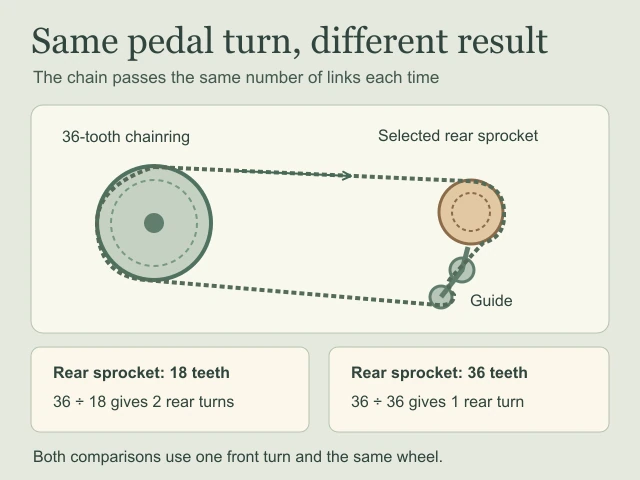
Original full drivetrain comparison. The 36-to-18 and 36-to-36 tooth pairs are illustrative arithmetic, without prescribing gear choice or equipment service.
Original Manthoryn educational illustration · CC BY 4.0. CC BY 4.0 ↗ · Image source ↗
A few details change the picture.
Follow the chain rather than the label
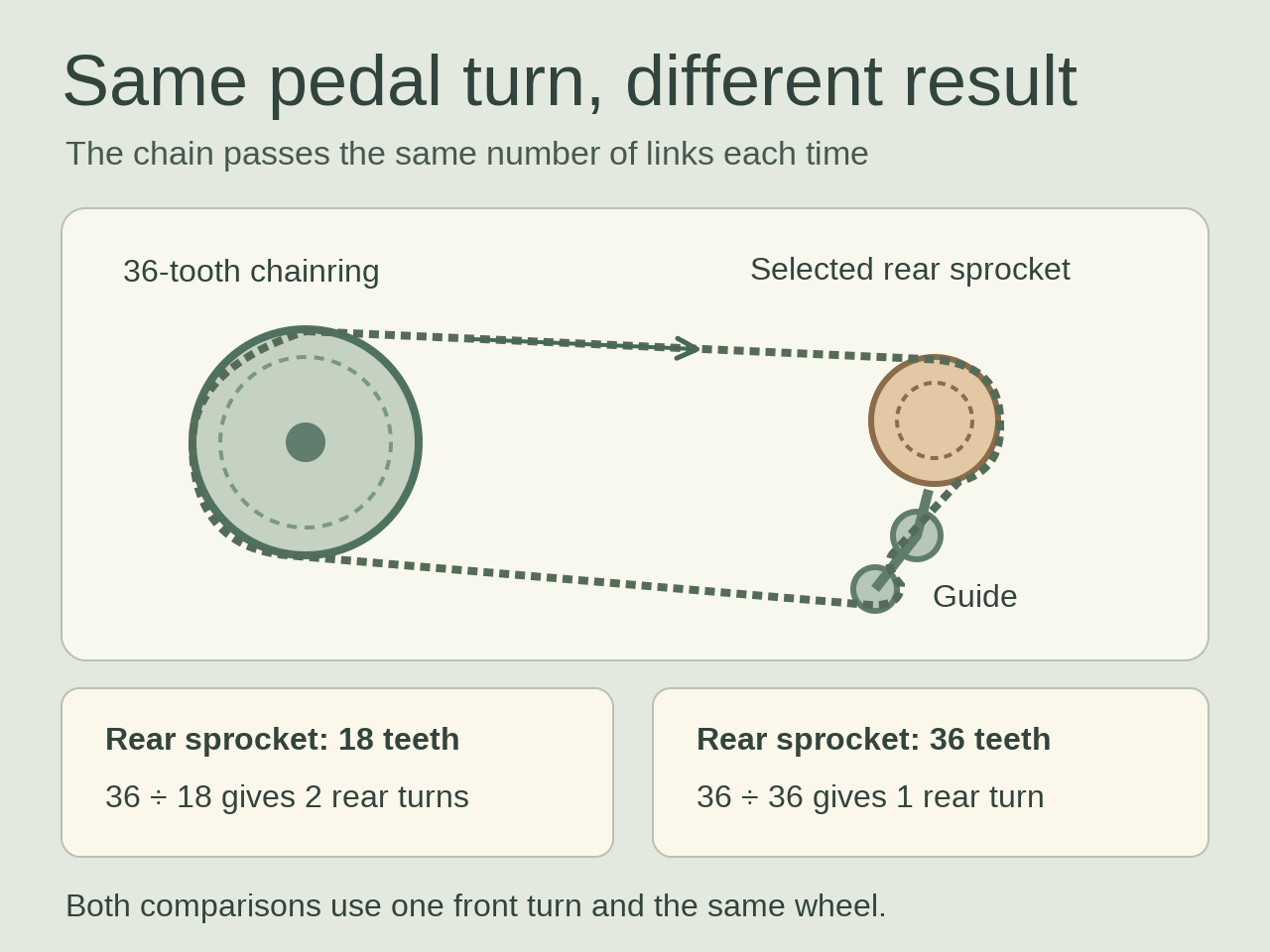
Suppose the front ring has 36 teeth. One turn advances the chain by 36 link pitches. If the chain wraps a rear sprocket with 18 teeth, those 36 pitches give two rear turns. A rear sprocket with 36 teeth gives one turn. That is the arithmetic in the teaching image, using invented sizes for comparison. [1][3]
The derailleur’s job is to choose the sprocket path
The cassette holds several sprockets together. A movable guide directs the running chain toward one of them. Changing the rear route also changes the path the chain must follow, so the derailleur includes a moving pulley cage. The chain and cogs transmit the turning effort when the drive is engaged. [1]
A speed trade-off, not free effort
For an ideal drive and the same pedal torque, a ratio that turns the wheel fewer times can produce more wheel torque. Torque is the turning effect of a force about an axis. Power also depends on how fast things turn, so selecting a ratio does not create power on its own. [3][1]
A ratio is only part of a moving bicycle
The wheel’s size affects the distance it rolls for each turn. Wind, slope and losses matter in a real ride. Keeping wheel size fixed here lets the change in sprocket size explain the comparison without turning the example into an instruction for a particular situation. [3][2]
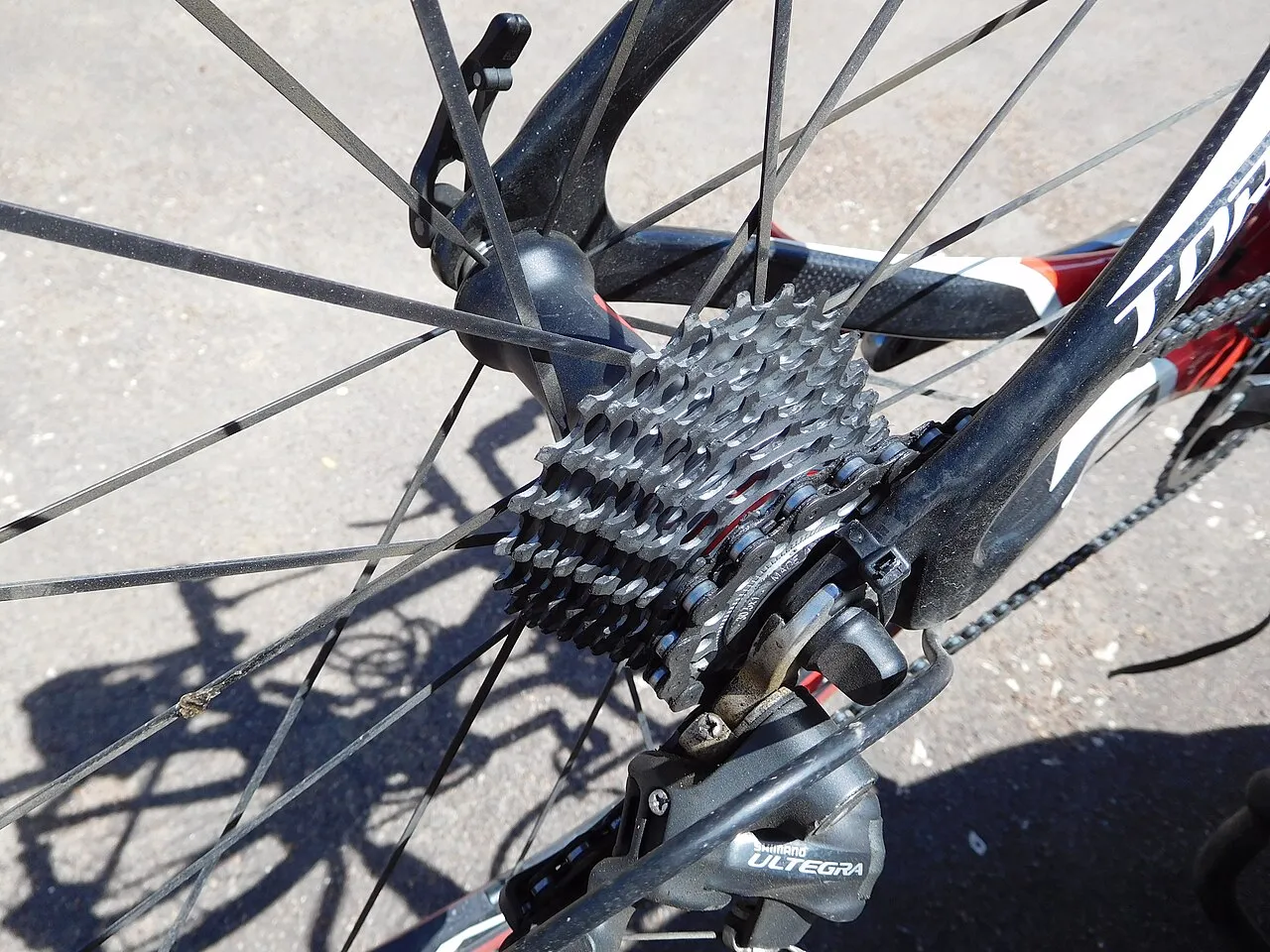
Ten-sprocket cassette and rear derailleur on a Torpado bicycle, photographed in 2017 by Cjp24. CC BY-SA 4.0. The illustrated tooth counts are separate teaching examples.
Cjp24 · CC BY-SA 4.0. Image rights ↗ · Image source ↗

Keep a little curiosity.
Enjoying a discovery is enough. These optional questions may become a deeper investigation.
With the same front chainring, what changes at the rear wheel if you select twice as many rear teeth?
The comparison assumes the same front input and wheel; it gives no riding or maintenance instructions.
A complete CEL answer is not published yet.
Plant a Seed for this question →Sources & image notes.
Facts are tied to the references below. This is a source-checked editorial discovery, rather than an assessment or a claim of independent expert review.
- Rear Drive System ↗
Shimano technical service documentation. Sprocket sizes, guide pulley, rear derailleur path through a cassette and movement from one rear sprocket to another.
Checked 2026-11-17. - Wheels and Wheeling ↗
Smithsonian Institution, Smith Hempstone Oliver and Donald H. Berkebile. Chain-driven rear wheel as a historical development and equipment context; no reproduction of images.
Checked 2026-11-17. - Simple Machines ↗
OpenStax, Physics. Ideal machine gives speed/travel versus force trade-offs; no extra energy from gearing.
Checked 2026-11-17. - Bicycle cassette – 10 speed ↗
Cjp24. Exact close documentary view of 10-sprocket cassette and Shimano Ultegra derailleur on a Torpado bicycle, CC BY-SA 4.0.
Checked 2026-11-17.
Image provenance and modifications
Some collection cards show a labelled detail crop. The full image above retains its source framing.
Illustration
Original full drivetrain comparison. The 36-to-18 and 36-to-36 tooth pairs are illustrative arithmetic, without prescribing gear choice or equipment service.
Original Manthoryn educational illustration · CC BY 4.0.
Creator/publisher: Original Manthoryn educational illustration / Manthoryn.
Source record · Original image · Original Manthoryn educational illustration, CC BY 4.0. No photograph, brand artwork, athlete likeness or proprietary diagram reproduced.
Changes: Original labelled SVG rasterized to two WebP widths without cropping.
Rights/source metadata checked 2026-11-17. Images identify the object or work; factual claims rely on the editorial references.
Photograph
Ten-sprocket cassette and rear derailleur on a Torpado bicycle, photographed in 2017 by Cjp24. CC BY-SA 4.0. The illustrated tooth counts are separate teaching examples.
Cjp24 · CC BY-SA 4.0.
Creator/publisher: Cjp24 / Wikimedia Commons.
Source record · Original image · Original photographer’s CC BY-SA 4.0 release. Same licence retained for full-frame WebP renditions.

Changes: Full Commons JPEG rendition retained. The image was resized and encoded at two widths without cropping or recolouring.
Rights/source metadata checked 2026-11-17. Images identify the object or work; factual claims rely on the editorial references.
Discovery entry.ce3-sports-rear-derailleur · revision 1.0.0. Raise a content or image concern →. This prepares a local note; no report is delivered.