Game Boy DMG-01: a game machine you could carry
A built-in screen and interchangeable cartridge made portable play a system, with new constraints of its own.
Before you start a game on the original Nintendo Game Boy, the pieces of a small system are already in your hands. The screen, directional control and speaker travel with you. Four AA batteries supply power, and a separate cartridge carries the game. Taking the system with you changes where play can begin and what it takes to keep playing. [1]
← Explore Game Consoles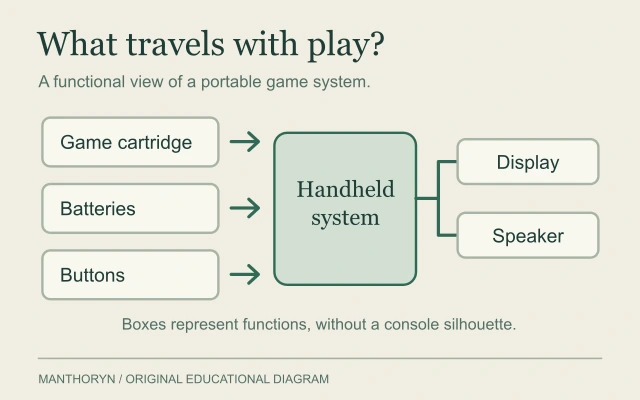
Original functional diagram of portable play. The rectangular forms are generic and do not depict the DMG-01’s industrial design.
Original Manthoryn educational illustration · CC BY 4.0. CC BY 4.0 ↗ · Image source ↗
A few details change the picture.
What travels with you?
The cartridge, batteries and controls have different roles. Changing cartridges changes the game, while the screen and buttons remain with the console. Replacing batteries supplies energy for the system already in your hands. Grouping the parts by function makes the machine easier to read than treating it as one gray object. [1]
What should be legible on a small screen?
Imagine a game two people can take turns playing during a trip. A ladder, a moving character and a doorway need to be easy to tell apart without much room between them. A game designer can use a stronger silhouette, simplify a busy background or leave more space between moving objects. These are classroom design possibilities, rather than claims about a particular team’s intentions. [1]
A shared set of controls
A directional pad and action buttons recur on the same hardware even when a new cartridge changes their meaning. In one imaginary design, an action button opens a door. In another, it confirms a choice from a list. The graphics change, but the physical interface helps a player find where to act. Familiar controls only help if the particular game makes their current function understandable. [1]
A portable system has a budget
A machine that people can carry still has limited screen area and finite battery energy. Consider what would happen if you doubled a display’s size but held the outer dimensions and battery space constant. Something else would have to occupy less space, or the system would need to work differently. The DMG-01 provides a real object for thinking about those competing requirements. [1]
Keep a little curiosity.
Enjoying a discovery is enough. These optional questions may become a deeper investigation.
How would you make three different actions recognizable using the same two buttons?
This is a portable interface-design question, separate from the histories of individual games.
A complete CEL answer is not published yet.
Plant a Seed for this question →Sources & image notes.
Facts are tied to the references below. This is a source-checked editorial discovery, rather than an assessment or a claim of independent expert review.
- Nintendo Game Boy games console, DMG-01 ↗
Science Museum Group. Exact object, year, Japanese manufacturer, batteries, cartridge, speaker and controls. Museum photo is excluded from reuse.
Checked 2026-11-17.
Image provenance and modifications
Some collection cards show a labelled detail crop. The full image above retains its source framing.
Illustration
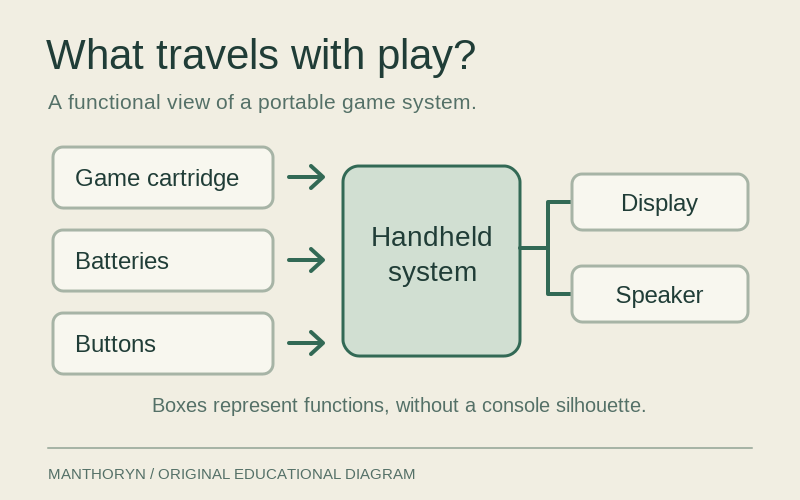
Original functional diagram of portable play. The rectangular forms are generic and do not depict the DMG-01’s industrial design.
Original Manthoryn educational illustration · CC BY 4.0.
Creator/publisher: Original Manthoryn educational illustration / Manthoryn.
Source record · Original image · Original Manthoryn educational illustration, licensed under CC BY 4.0 International.
Changes: Original SVG converted proportionally into local WebPs at two widths.
Rights/source metadata checked 2026-11-17. Images identify the object or work; factual claims rely on the editorial references.
Discovery entry.ce3-gaming-game-boy-portability · revision 1.0.0. Raise a content or image concern →. This prepares a local note; no report is delivered.