A bounce that stops: game physics on purpose
One carefully chosen simplification can make simulated motion easier to read.
A ball drops, bounces high once, and then makes a succession of smaller hops. In a game, those last motions may be so small that the ball just seems to shake against the floor. A simulation can treat very slow contacts as inelastic, bringing tiny bounces to an end. Each collision changes the motion, and the rule for the smallest ones changes how the result feels. [1]
← Explore Game Physics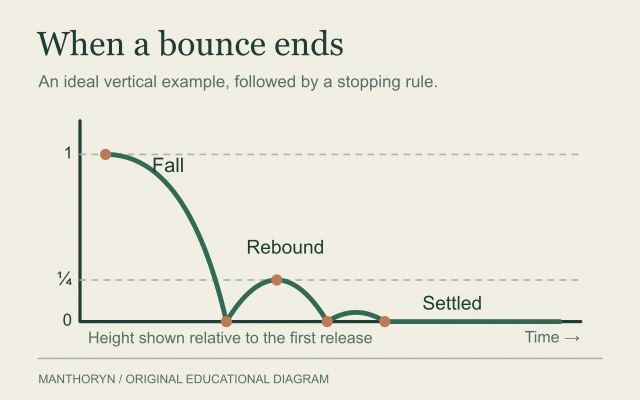
Original qualitative motion trace with authored values. Heights illustrate the idealized relation and do not come from a Box2D run.
Original Manthoryn educational illustration · CC BY 4.0. CC BY 4.0 ↗ · Image source ↗
A few details change the picture.
A fall and a collision are different moments
While the ball is falling, gravity changes its speed. At the floor, the contact changes its direction. A simple game model can separate these phases and express the contact as a rule that sets the speed just after the bounce. With a fixed floor and a vertical impact, a rebound speed of half of the approach speed is one possible choice. [1][2]
Half the speed, a quarter of the height
During the upward part of the next flight, gravity slows the ball until it reaches the top. Under the same constant gravity and without air resistance, peak height above the floor scales as speed squared. A ball returning upward at half the speed it had a moment before impact reaches one quarter of its previous peak, if that previous fall also began from rest. [2]
Give tiny bounces a stopping point
If this idea were repeated forever in an ideal calculation, the arcs would become smaller and smaller. A physical simulation has finite time and resolution. Box2D documents a small-velocity simplification that treats those contacts as inelastic. The illustrated stopping point is a teaching example and is not an engine setting. [1]
What the rule helps a player see
A ball that settles can tell a player the movement has ended. A deliberately springy object might need a longer visible bounce. Neither design decision tells us the exact behavior of a real rubber ball on a particular surface. The model earns its place by making a specific part of motion predictable and readable within a game. [1][2]
Keep a little curiosity.
Enjoying a discovery is enough. These optional questions may become a deeper investigation.
What should change when a game’s ball is meant to feel like a soft cushion rather than a spring?
This asks about a fictional game model. Surface, spin and deformation would matter in a real collision.
A complete CEL answer is not published yet.
Plant a Seed for this question →Sources & image notes.
Facts are tied to the references below. This is a source-checked editorial discovery, rather than an assessment or a claim of independent expert review.
- Box2D simulation documentation: Restitution ↗
Box2D project. Coefficient of restitution, approximate contact solver, and inelastic low-speed handling to suppress jitter.
Checked 2026-11-17. - University Physics Volume 1: Motion with constant acceleration ↗
OpenStax, Rice University. Constant-acceleration equation. The rebound-height comparison is derived for the stated model.
Checked 2026-11-17.
Image provenance and modifications
Some collection cards show a labelled detail crop. The full image above retains its source framing.
Illustration
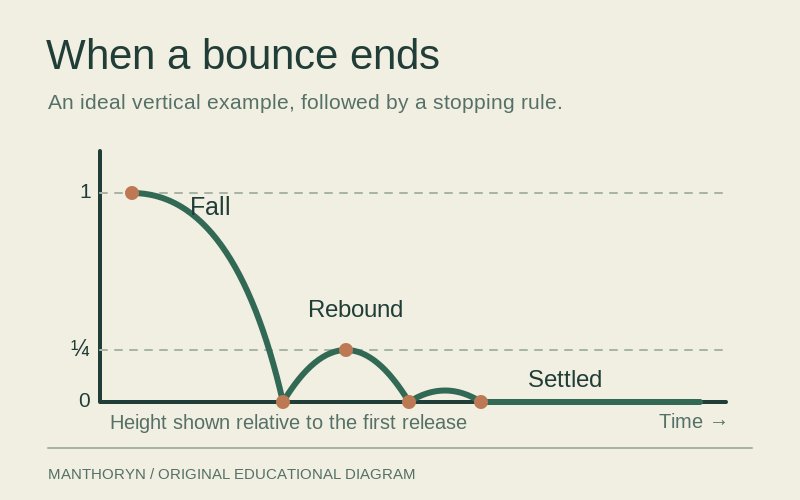
Original qualitative motion trace with authored values. Heights illustrate the idealized relation and do not come from a Box2D run.
Original Manthoryn educational illustration · CC BY 4.0.
Creator/publisher: Original Manthoryn educational illustration / Manthoryn.
Source record · Original image · Original Manthoryn educational illustration, licensed under CC BY 4.0 International.
Changes: Original SVG converted proportionally into local WebPs at two widths.
Rights/source metadata checked 2026-11-17. Images identify the object or work; factual claims rely on the editorial references.
Discovery entry.ce3-gaming-bounce-model · revision 1.0.0. Raise a content or image concern →. This prepares a local note; no report is delivered.