A maze with a landmark you can come back to
A memorable sight can make a repeated intersection feel like a place you already know.
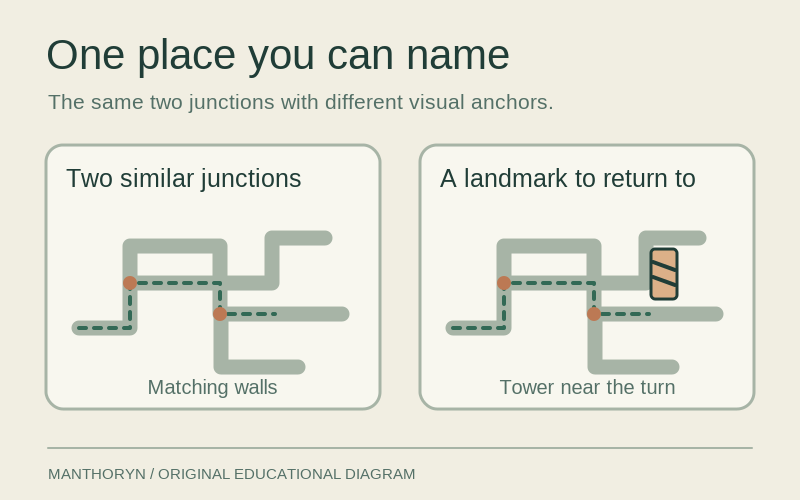
Two paths turn a corner and arrive at identical junctions. One junction has a tall striped tower that you can glimpse from several directions. The other offers only another stone wall. In the imaginary maze, you can describe the first location in a way your companion might recognize: the intersection beside the tower. A landmark gives an otherwise anonymous choice somewhere to attach. [1]
← Explore Game Worlds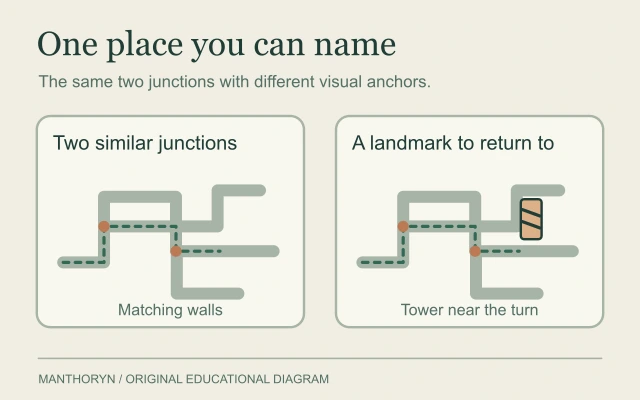
Original paired maze plans. These paths are fictional and were not used in the cited study.
Original Manthoryn educational illustration · CC BY 4.0. CC BY 4.0 ↗ · Image source ↗
A few details change the picture.
The difference a visible object can make
Imagine taking the north path while a friend takes the east path. If both later report seeing the tower, you have one point in common when you compare their routes. If there are several identical towers, that shared description may become ambiguous again. A cue is useful because of its relation to other parts of a route as well as its appearance. [1]
Use two kinds of orientation clues
Near a particular junction, a distinctive marker can help identify that choice. From far away, a taller object can offer a reference for a broader direction. The same object does not have to do both jobs. The example places the tower where a route can leave it behind and later see it again, making a return easier to describe. [1]
More markers do not guarantee better maps
In two virtual-environment experiments, researchers compared participants who could place landmarks with comparison groups. People often chose similar kinds of locations. Placement did not bring a significant wayfinding advantage in the second experiment and was associated with poorer sketch-map performance in the first. Those tasks are narrower than all the reasons a designer might use a memorable landmark. [1]
Make a detour worth taking
Give a side passage an enticing view, then consider what information a player has on the way back. If the tower disappears behind a wall and a path divides, a second cue close to the fork might help. You could test a sketch by following each junction from how it will look on foot, rather than only tracing it from above. [1]
Keep a little curiosity.
Enjoying a discovery is enough. These optional questions may become a deeper investigation.
At what point would the tower stop helping if a wall blocked it halfway along your return?
The route and tower are invented. The question concerns a specific orientation cue and its visibility.
A complete CEL answer is not published yet.
Plant a Seed for this question →Sources & image notes.
Facts are tied to the references below. This is a source-checked editorial discovery, rather than an assessment or a claim of independent expert review.
- Supra-individual consistencies in navigator-driven landmark placement for spatial learning ↗
Rul von Stülpnagel, Saskia Kuliga, Simon J. Büchner and Christoph Hölscher, eScholarship. Two experiments, placement results and possible roles of landmarks near decision points. No claim of general effect size.
Checked 2026-11-17.
Image provenance and modifications
Some collection cards show a labelled detail crop. The full image above retains its source framing.
Illustration
Original paired maze plans. These paths are fictional and were not used in the cited study.
Original Manthoryn educational illustration · CC BY 4.0.
Creator/publisher: Original Manthoryn educational illustration / Manthoryn.
Source record · Original image · Original Manthoryn educational illustration, licensed under CC BY 4.0 International.
Changes: Original SVG converted proportionally into local WebPs at two widths.
Rights/source metadata checked 2026-11-17. Images identify the object or work; factual claims rely on the editorial references.
Discovery entry.ce3-gaming-maze-landmarks · revision 1.0.0. Raise a content or image concern →. This prepares a local note; no report is delivered.