Sensorama: a ride made of coordinated cues
Morton Heilig’s patent put film, directional sound, air, scent and vibration around one viewer.
Imagine sitting beneath a hood and seeing a moving street ahead. A sound seems to come from one side and a change in airflow arrives at the same moment as the picture suggests movement. Morton Heilig’s Sensorama patent treats each of these sensations as a track in one presentation. The hoped-for experience comes from what the viewer receives together. [1]
← Explore Virtual Reality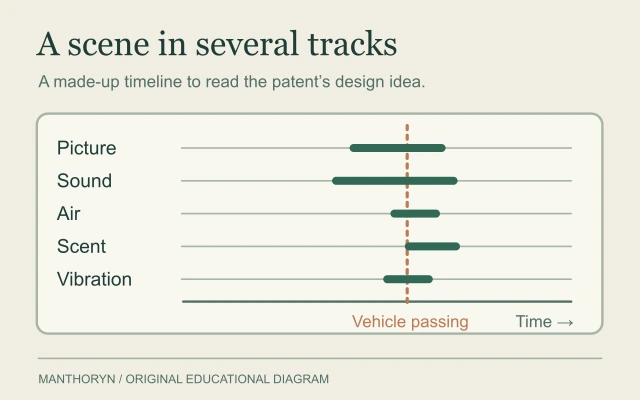
Original qualitative timing example. It is not a patent drawing or a reconstruction of a historic film sequence.
Original Manthoryn educational illustration · CC BY 4.0. CC BY 4.0 ↗ · Image source ↗
A few details change the picture.
Put each sense on its own path
The patent describes optical arrangements to produce a visual presentation and separate ways to deliver sound, moving air and scent. The single-viewer description also includes a vibration mechanism. A drawing that shows only a screen would miss much of the proposal. The timing chart here shows functions, leaving the historic machine’s shape and patent drawings to the source. [1]
One event can have several tracks
Suppose the scene has a vehicle passing from left to right. The sound and picture need to agree about where it is as it moves. Add a gust a moment before the picture suggests it, and the cue might be difficult to connect to the vehicle. The passing vehicle example is invented to show why a timing difference can change how the parts fit. [1]
A programmed presentation has a limit
A film track can be played repeatedly with related effects triggered at chosen points. That is different from recalculating a scene when a viewer looks or travels somewhere unexpected. The patent includes several proposed arrangements. It is evidence for what the inventor disclosed, and the list of disclosed functions by itself cannot verify every unit’s behavior. [1]
Read a design document as evidence
Read the patent’s equipment descriptions alongside its claims about how realistic the experience might be. A mechanism can be described precisely while the strength of the experience remains a proposal. Testing that effect would require viewers, a defined comparison and evidence about their responses. This distinction gives the historic patent more to tell us than a race to label a first. [1]
Keep a little curiosity.
Enjoying a discovery is enough. These optional questions may become a deeper investigation.
Which cue would be most revealing to delay if you wanted to test whether timing changes the experience?
A question about a controlled comparison, with no claim about historic viewers’ measured reactions.
A complete CEL answer is not published yet.
Plant a Seed for this question →Sources & image notes.
Facts are tied to the references below. This is a source-checked editorial discovery, rather than an assessment or a claim of independent expert review.
- Sensorama simulator, US3050870A ↗
United States Patent Office, Morton L. Heilig. US patent dates, optical viewing, film transport, sound, air, scent and vibration proposals. Claims in the patent are not measured outcomes.
Checked 2026-11-17.
Image provenance and modifications
Some collection cards show a labelled detail crop. The full image above retains its source framing.
Illustration
Original qualitative timing example. It is not a patent drawing or a reconstruction of a historic film sequence.
Original Manthoryn educational illustration · CC BY 4.0.
Creator/publisher: Original Manthoryn educational illustration / Manthoryn.
Source record · Original image · Original Manthoryn educational illustration, licensed under CC BY 4.0 International.
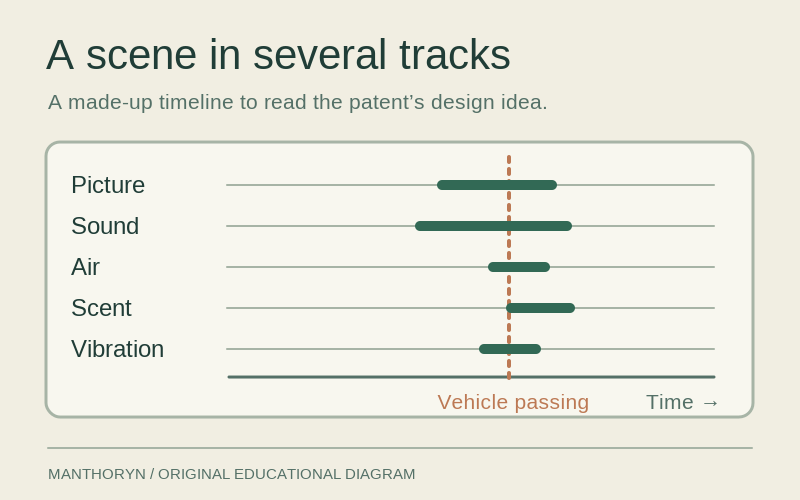
Changes: Original SVG converted proportionally into local WebPs at two widths.
Rights/source metadata checked 2026-11-17. Images identify the object or work; factual claims rely on the editorial references.
Discovery entry.ce3-gaming-sensorama-cues · revision 1.0.0. Raise a content or image concern →. This prepares a local note; no report is delivered.