Magnavox Odyssey
White shapes on a television, with a whole game spread around them.
In 1972, the Magnavox Odyssey brought video games into the home television. Its electronic images were spare: small white shapes and a line. Color, settings and much of the play came from translucent screen overlays, printed materials and the people gathered around the set. [1][3]
← Explore Game Consoles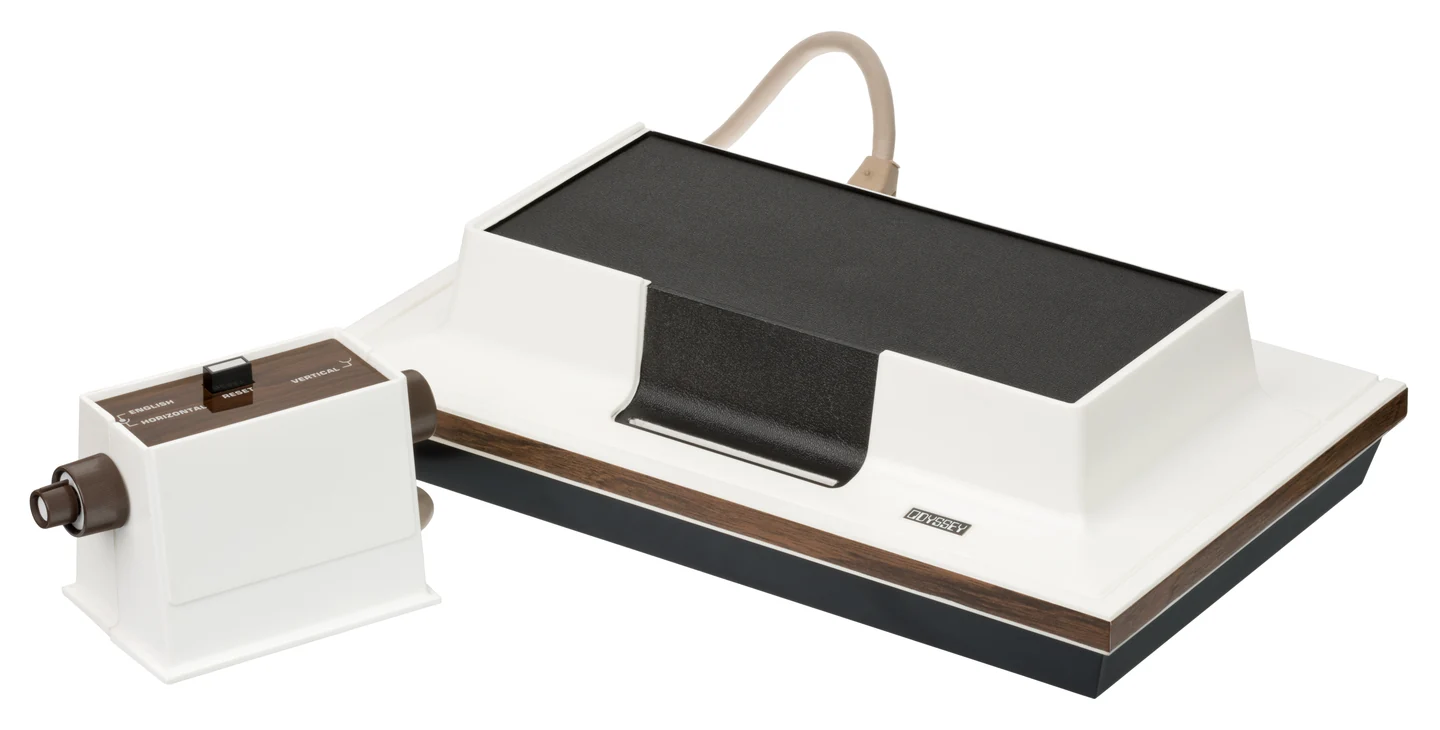
The original Magnavox Odyssey with one of its two controllers, photographed by Evan-Amos. The photograph contains hardware rather than game screenshots or promotional artwork.
Evan-Amos / Wikimedia Commons — public domain Public domain ↗ · Image source ↗
A few details change the picture.
The game cards changed the available electronic mechanics; they were not self-contained software games in the modern sense. One set of mechanics could serve different games. [2]
Two wired controllers used dials rather than today’s familiar button-and-stick layout. Players adjusted the moving shapes while consulting rules supplied outside the screen. [2][3]
Dice, playing cards, game chips and paper money accompanied the electronics. The living-room game could extend well beyond the television itself. [3]
From a prototype to the living room
The Odyssey grew from Ralph Baer’s Brown Box prototype. Powerhouse documents the prototype’s role in demonstrating television games to Magnavox, followed by the commercial system in 1972. The new product replaced the prototype’s wooden appearance with a distinctive plastic housing; MoMA now holds an example in its Architecture and Design collection. [3][4]
A game larger than the screen
The television did not explain the whole experience. Smithsonian’s account describes a manual, six game cards, two controllers and supporting materials. With no on-screen instructions or background scenes, players supplied a setting using overlays and learned each activity from the written rules. A simple electronic display could therefore support several very different imagined situations. [2][1]
That division of labor is the Odyssey’s most inviting detail: electronics moved the shapes, while physical components and agreed rules made them meaningful. The Smithsonian notes that players could even alter the rules or combine components. This early console offered a kit for shared play rather than a completely enclosed digital world. [2]
Keep a little curiosity.
Enjoying a discovery is enough. These optional questions may become a deeper investigation.
How can an early television game system make shapes appear and move on a screen?
A dedicated explanation of the Odyssey’s television signals and electronics is not published here. The contextual Plant a Seed suggestion remains editable.
A complete CEL answer is not published yet.
Plant a Seed for this question →Another story to explore.
Editorial suggestions for browsing, with the reason shown. These are not canonical knowledge-graph relationships.
Sources & image notes.
Facts are tied to the references below. This is a source-checked editorial discovery, rather than an assessment or a claim of independent expert review.
- Magnavox Odyssey Video Game Unit, 1972 ↗
Smithsonian National Museum of American History. Brown Box origins; minimal white blocks and vertical line; translucent overlays supplying settings and layouts. The museum image itself is not reused.
Checked 2026-11-14. - The Magnavox Odyssey predicted the future of video games ↗
Smithsonian National Museum of American History — Drew Robarge. 1972 home television context; six game cards and two dial controllers; electronic mechanics rather than standalone software games; manual, physical components, no screen instructions and scope for players to adapt rules.
Checked 2026-11-14. - ‘Magnavox Odyssey’ video game console, object 2014/5/1 ↗
Powerhouse Collection. Baer and Brown Box development, Magnavox manufacture in 1972, physical console and controllers, overlays and board-game components. Only factual research is used; Powerhouse images are not reused.
Checked 2026-11-14. - Ralph Baer. Magnavox Odyssey. 1972 ↗
The Museum of Modern Art. Ralph Baer, 1972, manufacturer Magnavox USA, plastic/electronics medium and Architecture and Design collection context.
Checked 2026-11-14.
Image provenance and modifications
Some collection cards show a labelled detail crop. The full image above retains its source framing.
Photograph
The original Magnavox Odyssey with one of its two controllers, photographed by Evan-Amos. The photograph contains hardware rather than game screenshots or promotional artwork.
Evan-Amos / Wikimedia Commons — public domain
Creator/publisher: Evan-Amos / Wikimedia Commons.
Source record · Original image · Public domain: released worldwide by the photographer; fallback permission for any purpose without conditions except those required by law


Changes: EXIF orientation normalized and proportionally resized to WebP at 480, 960 and 1440 pixels wide; no crop, generative modification, object removal or color alteration.
Rights/source metadata checked 2026-11-14. Images identify the object or work; factual claims rely on the editorial references.
Discovery entry.magnavox-odyssey · revision 1.0.0. Raise a content or image concern →. This prepares a local note; no report is delivered.