The Abydos Senet board: what thirty squares tell us
Surviving blue inlays show where pieces might travel, while restoration and missing instructions set limits.
Start with the blue tiles on this game box. Some were excavated in Tomb D99 at Abydos. Others were made in modern times to fill spaces in the restored display. The wooden box that supports them is modern. The object can still tell us a surprising amount, if we keep the surviving evidence separate from what a restorer or a scholar has added. [1]
← Explore History of Gaming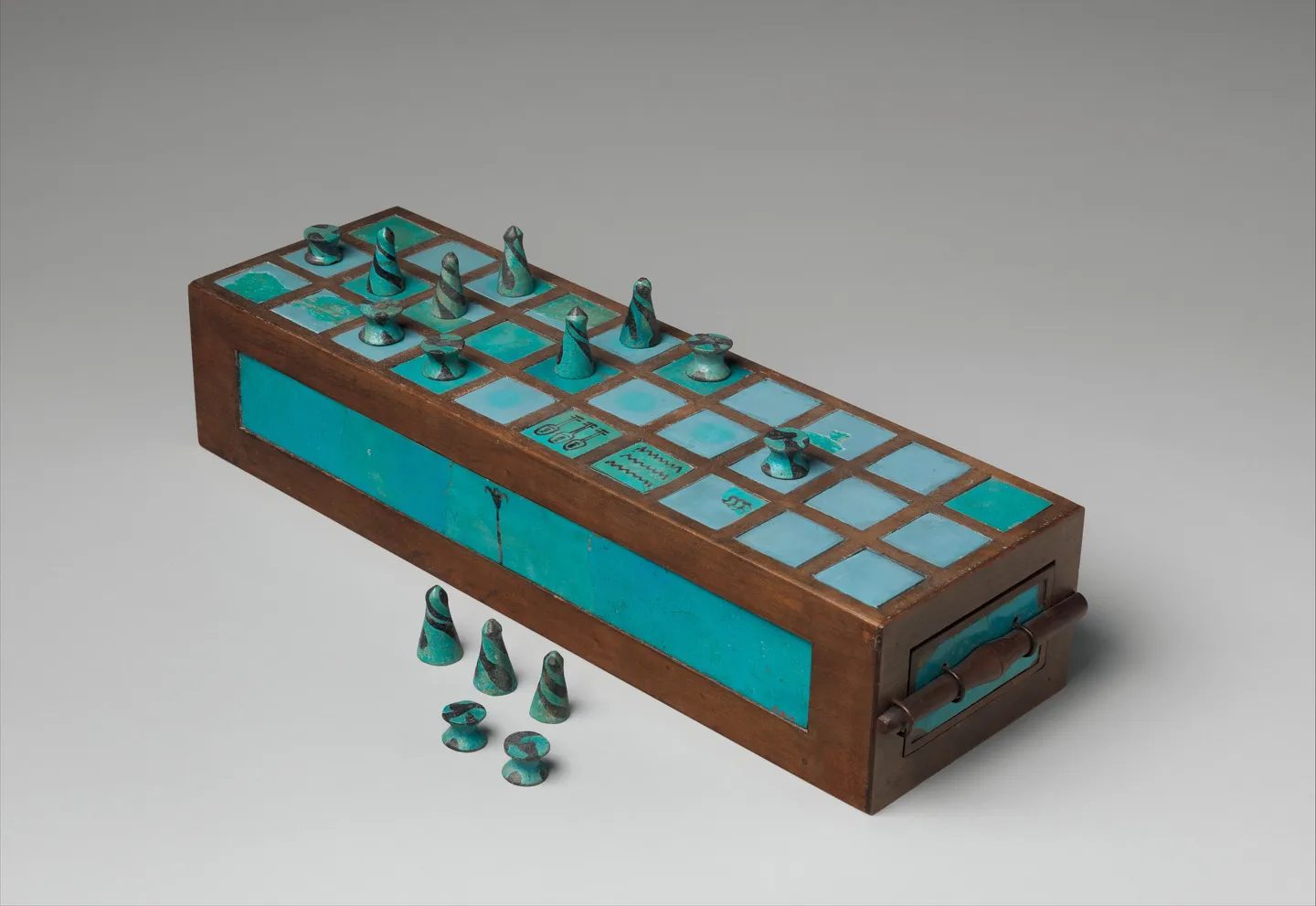
The Met’s photograph of the restored display of 01.4.1a. Ancient faience inlays and modern replacements occupy a modern wooden box.
The Metropolitan Museum of Art, Gift of Egypt Exploration Fund, 1901. 01.4.1a. Public Domain (CC0). Public domain / CC0 ↗ · Image source ↗
A few details change the picture.
Count spaces and look for marks
The playing surface is organized in three rows of ten. The Met’s discussion identifies a mark for good near the end of the path and a sign for water in the next square. This kind of detail matters. A pattern of decorated positions can suggest repeated differences in play that would be easy to miss if you saw only a grid. [1][2]
Try a route as an interpretation
The museum’s account interprets the route as bending back and forth across the three rows. It discusses how some squares could give an advantage or create a hazard. A surviving mark gives a firm place to start. The exact consequences of a move also depend on how different evidence is interpreted and on the period or board under discussion. [2][3]
One box can carry more than one game
The two faces help separate the objects used for play from any one set of rules. The other game has twenty spaces, with a different layout and history. It would be easy to import a convenient rule from that game into a reconstruction of Senet. Keeping the faces apart helps expose where a tempting explanation depends on evidence from elsewhere. [1][3]
A game in a tomb can have several meanings
Senet is represented in burial contexts and had associations with passage to the afterlife in the New Kingdom. That connection does not say what every player thought during a turn or make every game piece a ritual object. The material evidence, visible rules and burial setting give us different questions to ask of the same thing. [2][3]
Keep a little curiosity.
Enjoying a discovery is enough. These optional questions may become a deeper investigation.
What piece of evidence would help decide between two proposed meanings for the same marked square?
A source-evaluation question. An exact modern rule reconstruction requires comparative evidence and specialist review.
A complete CEL answer is not published yet.
Plant a Seed for this question →Sources & image notes.
Facts are tied to the references below. This is a source-checked editorial discovery, rather than an assessment or a claim of independent expert review.
- Gameboard and Gaming Pieces, 01.4.1a ↗
The Metropolitan Museum of Art, Egyptian Art Department. Exact find, period, identity and restored construction. Exact figure in the public-domain image gallery.
Checked 2026-11-17. - Senet and Twenty Squares: Two Board Games Played by Ancient Egyptians ↗
The Metropolitan Museum of Art, Danielle Zwang. Marked squares on the exact board, reconstructed route, and New Kingdom funerary connections.
Checked 2026-11-17. - Board Games from Ancient Egypt and the Near East ↗
The Metropolitan Museum of Art. Comparative curatorial account of Senet and Twenty Squares across distinct boards and contexts.
Checked 2026-11-17.
Image provenance and modifications
Some collection cards show a labelled detail crop. The full image above retains its source framing.
Photograph
The Met’s photograph of the restored display of 01.4.1a. Ancient faience inlays and modern replacements occupy a modern wooden box.
The Metropolitan Museum of Art, Gift of Egypt Exploration Fund, 1901. 01.4.1a. Public Domain (CC0).
Creator/publisher: The Metropolitan Museum of Art / The Metropolitan Museum of Art.
Source record · Original image · The exact Met image is designated Public Domain and released by The Met under CC0.

Changes: Exact institutional JPEG retained. Derived full-frame WebPs resize the image proportionally and retain its original color and composition.
Rights/source metadata checked 2026-11-17. Images identify the object or work; factual claims rely on the editorial references.
Discovery entry.ce3-gaming-senet-abydos · revision 1.0.0. Raise a content or image concern →. This prepares a local note; no report is delivered.