How do organisms obtain usable energy from food?
Cells use linked reactions to transfer some of the energy available from food into forms they can use. During aerobic respiration, glucose is oxidized and its carbon can leave as carbon dioxide. Electron transfer helps build a proton gradient across an inner mitochondrial membrane. The return flow of protons powers production of ATP, short for adenosine triphosphate. ATP then helps drive work such as muscle contraction, and energy also disperses as heat. Breathing supplies oxygen and helps remove carbon dioxide through the blood. The reactions that use oxygen and produce ATP take place in cells.
Imagine the leg of a person climbing a step. A muscle needs to keep contracting even though a mouthful of food is nowhere near it. That gap leads to three different jobs: delivering substances, converting energy in a cell and using it to do work. Keeping those jobs separate makes it possible to reason about what happens if one of them slows.
Stages organize this explanation. They do not mark it studied or award understanding.
Start with the question
The answer, the explanatory gap and useful foundations.
Read in your own way
Start with the answer, refresh a foundation when you need it, or follow the explanation through. The investigation lets you predict and compare reasoning before trying a new case.
Everything here is open without an account. Saving is optional. The public subject tree is a map of published ideas; My Forest contains the subjects you choose to plant.
See the public Biology tree →A foundation, without a detour.
Begin with a muscle cell as our boundary. A molecule can enter, leave or change through a reaction, so we can track the atoms wherever they go. We can also track transfers of energy, such as a movement or warming of the surroundings. These are different accounts of the same events.
Matter can be counted
Atoms are parts of molecules. A chemical reaction rearranges atoms into different molecules. Counting an element before and after a reaction checks that the proposed inputs and outputs account for it.
Energy can be transferred
Moving an object, warming water and changing a chemical mixture all involve energy. The ability to drive a particular change depends on the starting and ending states and on whether there is a mechanism that couples them.
Develop the model
Follow the first explanatory steps without losing their qualifications.
Delivery brings the materials to the cell
Imagine following a glucose molecule to the muscle that helps push a foot against a step. Digestion has made small molecules available to absorb, and blood can deliver dissolved glucose to tissues. Blood also delivers oxygen from the lungs. Those are two routes to one work site. Inside the muscle cell, proteins called enzymes guide the sequence of reactions that make useful energy transfers possible.
Breathing moves air. Gas exchange lets oxygen enter the blood and carbon dioxide move the other way at the lungs. Inside the muscle, cellular respiration is a sequence of reactions. A person could inhale oxygen without it ever reaching our particular muscle cell if circulation stopped. And the presence of glucose and oxygen in the same space does not by itself give the cell a mechanism for turning a muscle protein.
The cell needs chemical work even when the person is between steps. Some of its proteins move substances across membranes, and others make new molecules. Our motion example gives one destination for a transfer that the cell can also use in many other ways.
Moving a substance to a cell and using that substance in a reaction are different jobs.
Account for the atoms
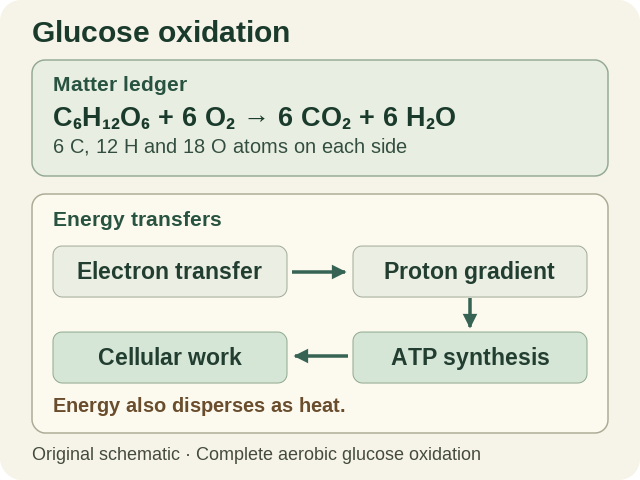
Consider the ideal case in which one glucose molecule is completely oxidized using oxygen. Its overall equation is C₆H₁₂O₆ + 6 O₂ → 6 CO₂ + 6 H₂O. The coefficient 6 counts molecules. The small numbers next to element symbols count atoms within each molecule. On either side there are 6 carbon, 12 hydrogen and 18 oxygen atoms.
In this overall account, the glucose carbon winds up in carbon dioxide. Carbon dioxide can move out of the cell and eventually be exhaled. Some glucose in a real person goes into other pathways instead, so the equation is a statement about the fraction that is completely oxidized. It does not assign all the carbon in a meal to the next breath.
Notice what the equation does not show. It leaves out the enzymes and many intermediate molecules. It does not trace each individual oxygen atom, and it gives no ATP yield. A balanced ledger tells us which totals a mechanism must respect. Finding what the cell can do with the reaction requires another kind of accounting.
Carbon atoms in fully oxidized glucose end up in carbon dioxide. The accompanying energy transfers require a separate account.
A sequence can couple one change to another
In the liquid outside the mitochondria but inside the cell, a pathway called glycolysis converts one six-carbon glucose molecule into two three-carbon products called pyruvate. Glycolysis spends ATP at first and makes more later, with a net gain of two ATP for one glucose in the standard pathway. It also transfers electrons to carrier molecules. Much of the potential for further energy transfer still remains in the products of these early reactions.
In our muscle-cell example, when complete aerobic oxidation proceeds, pyruvate goes into mitochondria. Further reactions release carbon dioxide and load electron carriers. Those carriers deliver electrons to a series of proteins in the inner mitochondrial membrane. Transfer of electrons toward their final acceptor, oxygen, is coupled to moving protons to the other side of the membrane. Oxygen accepts electrons and combines with protons to form water at the end of the chain.
This movement creates a difference in both concentration and electrical potential across the membrane. That difference makes it favorable for protons to return. ATP synthase is a protein that uses their return flow to add a phosphate to ADP, the corresponding molecule with two phosphate groups, making ATP with three. Linking those steps gives the cell a usable route from food reactions to ATP. The gradient has to be maintained as protons flow back.
Electron transfer builds a proton gradient. The return flow of protons can drive ATP production.
Investigate and refine
Predict, compare the lenses and carry the explanation further.
Pause with a concrete case. Make a prediction, then compare the explanation before continuing.
Follow the materials and the energy
The final electron acceptor in this route is unavailable, so the chain cannot keep rebuilding its proton gradient. Glycolysis uses a different route to make some ATP. It can continue under the stipulated glucose and carrier conditions. This is a comparison of causal dependencies, not a prediction of how long real cells can keep working.
Inputs supplied by the case
Oxygen delivery has stopped. The imagined cell still has glucose, ADP and phosphate, and can regenerate the electron carrier used in glycolysis.
Which step depends on which input?
Oxygen accepts electrons at the end of the mitochondrial chain. The gradient depends on continued proton pumping. Glycolysis can transfer phosphate to ADP without using that gradient.
Read the arrow as a dependency
Glucose breakdown, electron transfer, the gradient and ATP formation connect several changes. An arrow does not represent a glucose carbon atom being converted into energy.
ATP is made and used repeatedly
Back at the muscle protein, part of its movement cycle is linked to ATP binding and hydrolysis. Hydrolysis is a reaction with water that yields ADP and free phosphate. Because the whole ATP hydrolysis reaction is favorable under cellular conditions, the linked cycle can do work. Breaking a bond on its own takes an input of energy. The energy difference comes from comparing the complete reactants and products in their surroundings, including the bonds and interactions formed as the reaction proceeds.
ADP and phosphate can feed back into ATP production. The ATP molecule is matter, and its components can circulate through the production and breakdown cycle. The available energy is transferred along the way. We could follow some of it into lifting the body and some into warming the muscle and its surroundings. In the absence of a continuing source of available energy, recycling the same components would not keep powering work.
Which part of the process does a particular molecule belong to? One glucose carbon atom may leave through the blood as part of carbon dioxide. The carbon need not pass through an ATP molecule for glucose oxidation to help support ATP production. The useful link is the sequence of coupled reactions.
ATP components can be reused, while continuing work depends on continuing transfers of available energy.
Changing the conditions changes the pathway
In the aerobic chain in our example, if oxygen were unavailable, sustained electron transfer to oxygen could not maintain the gradient. ATP synthesis driven by that gradient would then be limited as the gradient dissipated. Yet glycolysis does not directly require oxygen. It can keep making some ATP if glucose remains available and its electron carrier is regenerated. Converting pyruvate to lactate is one way a muscle cell can regenerate that carrier. Lactate production can occur even with oxygen present, so it does not uniquely identify a lack of oxygen.
Other cells and organisms can use different fuels and pathways. For instance, mitochondria can obtain electron carriers and reaction intermediates by processing components of fats. A plant can use energy from light to help make sugars and can also perform cellular respiration. The glucose equation and our muscle-cell diagram describe a route, not a menu of every possible energy transfer.
Return to the step. The cell still needs both a supply of matter and a chain of coupled reactions to do work. An intervention could change either. Having a map of the chain lets us ask which particular transfer would be disrupted instead of concluding that the cell has simply run out of an undifferentiated substance called energy.
Which ATP pathways can continue depends on what can enter, what can be regenerated and what can drive each step.
Apply and connect
Try a new case, follow genuine relationships and check the sources.
Does your explanation travel?
Objective: Use the complete-oxidation model to distinguish the fate of glucose carbon from the production and use of ATP.
What does this check show?
The item tests the distinction between carbon accounting and energy transfer in the stated ideal case. It gives no evidence about clinical metabolism, ATP yield or laboratory tracing skills.
This is a low-stakes authored choice question. A supported answer is evidence for this item’s objective, not certification or permanent mastery.
Explanatory feedback: Complete glucose oxidation accounts for the six carbons in six carbon dioxide molecules. In this case it is the chain of linked reactions that supplies the energy transfer for ATP production. Following energy is a different task from tracing glucose carbon atoms.
A useful explanation has edges.
- The balanced equation is an idealized net count for complete glucose oxidation. It does not locate individual atom transfers, specify each enzyme or predict how much food follows the route.
- The muscle example assumes working mitochondria and ventilation and circulation in the starting case. The energy diagram is a qualitative map. It gives no ATP yield, heat fraction, exercise threshold or clinical advice.
- Glycolysis is one ATP source. Other fuels, fermentation pathways, alternative electron acceptors and ATP sources are outside this introductory account.
Follow the concepts.
A map can help you find a useful foundation or a different view. Every line below has a stated reason and a limit.
No direct published relationship is recorded for this selection yet. No connection is invented to fill the diagram.
Find a connected question with Seed Shuffle →Sources & authorship
This explanation was released through an explicit editorial review. Structural checks and an Owner or delegated editorial decision are not independent expert or scientific certification.
The sources below identify claim scope and consultation dates. Check the original material and its limits.
- Alberts et al., Molecular Biology of the Cell — How Cells Obtain Energy from Food ↗
The stages of glucose breakdown, glycolysis and fermentation, carbon dioxide production, oxidative phosphorylation, and the role of fats and sugars. The edition’s historical ATP yield estimates are not used.
Source consulted 2026-11-17 - Alberts et al., Molecular Biology of the Cell — Catalysis and the Use of Energy by Cells ↗
The distinction between free energy and matter, electron transfer, coupling of ATP formation and use, and recycling of ADP and phosphate. The lesson uses its own explanation and figures.
Source consulted 2026-11-17 - OpenStax Biology 2e §7.4 — Oxidative Phosphorylation ↗
Proton pumping across the inner mitochondrial membrane, oxygen reduction to water, ATP synthase, and variable ATP yield. This is a bibliographic reference. No textbook imagery, examples or wording are reproduced.
Source consulted 2026-11-17 - NHLBI, National Institutes of Health — What Breathing Does for the Body ↗
Movement of air into and out of the lungs, exchange of oxygen and carbon dioxide with blood, and transport between lungs and tissues. This source does not describe the detailed ATP pathway.
Source consulted 2026-11-17 - Brooks et al., The Journal of Physiology — Lactate in contemporary biology ↗
The section on lactate formation traces evidence for lactate production in oxygenated muscle. The lesson uses only that qualitative distinction and makes no claim about an exercise threshold or a clinical test.
Source consulted 2026-11-17
Lesson lesson.biology.cellular-respiration · Revision 1.0.0. Found a problem? Raise a content concern. This prepares a local note; no report is delivered by opening it.